Category Archives: Marketing Agency

Auto Added by WPeMatico

Why Growth Stalls After Early Success

Why Growth Stalls After Early Success written by John Jantsch read more at Duct Tape Marketing

Listen to the full episode:
In this solo episode of the Duct Tape Marketing Podcast, John Jantsch explores why capable, experienced founders repeatedly hit the same growth ceiling. He unpacks the hidden leadership patterns, behaviors, and internal bottlenecks that stall progress even when strong strategies are in place.

Episode Overview

John Jantsch takes a deeper look at one of the biggest reasons businesses stop growing: the founder becomes the bottleneck. While many organizations invest in strategy, tactics, and better marketing systems, real transformation often fails to stick because the founder’s mindset and leadership habits have not evolved.

In response, John introduces a new facilitated experience called Founder’s Day, designed to help business owners identify the assumptions, fears, and recurring behaviors that are limiting growth. This episode is a call for honest reflection and leadership change as the true starting point for organizational transformation.

About John Jantsch

John Jantsch is a marketing consultant, speaker, and bestselling author of Duct Tape Marketing, The Referral Engine, Duct Tape Selling, and Marketing Rebellion. He is the founder of Duct Tape Marketing and creator of the Marketing Operating System, helping small businesses and agencies build practical, effective strategies for long-term growth.

Key Takeaways

  1. Strategy alone is not enough.Even the best marketing strategy can stall if the founder’s leadership style and decision-making patterns remain unchanged.
  2. Founders are often the bottleneck.Overinvolvement, inconsistent delegation, and unclear accountability can keep teams from taking ownership.
  3. Growth ceilings are often self-created.Businesses frequently plateau because founders repeat the same patterns that helped them succeed early on.
  4. What got you here will not get you there.Reaching the next level of growth requires a different mindset, different leadership behaviors, and new systems.
  5. Founder’s Day is built for transformation.This new facilitated workshop helps founders surface the internal constraints holding back the business.
  6. Business goals must come first.Before building a strategy, companies need clarity on what the organization actually wants to achieve.
  7. The future of agencies is transformation.Agencies and consultants that move beyond selling tactics and start delivering transformation will stay more relevant.
  8. AI cannot replace a real system.AI can support execution, but it cannot replace a strategic framework like a marketing operating system.

Great Moments

  • 00:01 – John introduces the episode and asks why smart businesses keep hitting the same ceiling
  • 01:00 – Why better strategy alone does not always create better results
  • 02:11 – The signs that a founder may be the bottleneck
  • 03:00 – The cost of poor alignment and stalled execution
  • 04:00 – Introduction to Founder’s Day
  • 05:00 – Why business goals must guide marketing strategy
  • 06:00 – The role of self-awareness, reflection, and vulnerability
  • 07:00 – Why what got you here will not get you there
  • 08:10 – Building a personal change plan for leadership growth
  • 09:00 – Announcement of the Future Proofing Your Marketing Agency event
  • 10:00 – Selling transformation instead of tactics
  • 10:30 – Why AI will not replace strategic systems
  • 11:00 – How to register for the free event

 Quotes

The strategy, no matter how good it is, gets undermined if the founder doesn’t change.

In many cases, we have to move the founder out of the way of growth.

What got you here won’t get you there.

If all you’re doing is delivering value using AI tools, you’re going to be replaced by that very tool.

Real transformation starts with the founder, not the tactics.

Save your Free Seat

Register for the free three-day experience, Future Proofing Your Marketing Agency, running from March 31 through April 2.

Visit: dtm.world/future

  • Day 1: Founder’s Day experience
  • Day 2: Selling transformation
  • Day 3: Marketing Operating System introduction


John Jantsch (00:01.058)

Hello and welcome to another episode of the Duct Tape Marketing Podcast. This is John Jantsch and I’m going to do a solo show today. That’s right, just me, no guess. I want to talk about some things that…

You know, I can say that it’s been brewing recently, but you know, in hindsight, when I look back, it’s probably something that I’ve recognized over 20 years or so. And here’s the question I’m going to start with. Why do smart businesses, smart business owners keep hitting the same ceiling? That’s what I want to talk about today. I feel very qualified to talk about this because I’m a founder. I’ve experienced some of the same things I’m going to talk about today. And I think that that

Quite frankly, it’s helped me recognize why this is happening. So we work with a lot of founder led businesses and what we’ve typically found is they don’t have a very well developed strategy. I mean, we’ve built almost our entire practice on the idea of strategy before tactics and many of the clients come to us for a strategy first type of engagement. And while in every case,

They are helped. have better thoughts. They have better priorities. They have better tactics. One of the things that I’ve found is that even as the business grows, many times they come up against the same hurdle time and time again. A lot of it’s because the founders patterns have stayed the same. How they view the business, how they view delegating, how they view growth.

their fears. These are some of the things that I think really end up holding a business back so that it ultimately can’t necessarily change, even though we’ve installed a better marketing approach in many cases. what I’ve seen, here’s some of the things I’ve seen. Tell me if any of these apply to you. The founder is still very involved in every, or at least many decisions. The team,

John Jantsch (02:11.946)

if they’ve assembled one, kind of waits around for like, what do we do next rather than owning things? Delegation, while it’s a good idea, every quarter I’m going to really commit to it, never really sticks. There’s not a lot of accountability or it’s fuzzy as far as who’s going to do what. And so it’s like the business keeps circling around the same issues time and time again. So

I’m wondering, are you feeling that bottleneck? Do any of these symptoms or ideas sound familiar to you? And what’s it costing? I guess that’s the next question too. I know that when we have worked with a client, in some cases, when we can’t get past this issue, the strategy, no matter how good it is, it really stalls or gets undermined at least. Alignment that.

that hopefully sometimes comes out of this strategy engagement falls. People get hesitant. Growth certainly slows as well. what’s the solution? Well, one of the things that we have added, and we’re going to do it as a standalone, frankly, but certainly as part of or the front end of any strategy engagement that we do, is to add an element that we’re calling the Founder’s Day.

The idea behind this is to have a very intense guided, facilitated workshop, if you will, with the founder of the business before we ever start talking about their ideal client and their core message. Because I think real change, of course, has to start with that founder. And really before the business can transform, mean, a lot of times we have to teach them what it is that we’re going to install, but then also how we’re going to reinforce it.

Here’s what it is. It’s a structured, facilitated experience focused on the founder’s change. It’s not therapy, although maybe sometimes. It’s not really coaching or certainly not coaching theater that you sometimes see out there. It’s not a strategy session. It’s a process designed to really surface the patterns, the assumptions, the behaviors really that are actually limiting and holding back growth. the goal

John Jantsch (04:39.15)

to that day or to that session or that element, it’s not really just insight. mean, it’s to create a shift that can support the real organizational change that is going to come from us installing strategy first, installing a marketing operating system. So.

It’s going to begin with business goals. Again, that’s another thing I think is I’ve learned the hard way, but I think it’s sort of odd that a lot of marketing folks get hired to do marketing plans, to do marketing strategy, to do marketing tactics. And there really hasn’t been much discussion, if at all, about what the goals of the organization are, what the goals of the business are. And we really need to tie those two things together. So we’re going to start there, really get very clear on what the company wants.

before we start talking about how the founder is going to change in order to get there. And then of course how marketing is going to eventually support that. So.

John Jantsch (05:45.516)

we’re going to move, I think we’re going to ask you to make some honest reflection to help move you out of the way of growth. I know that sounds really harsh and I can say it again. I think I could say it because frankly, I’ve lived it myself. In many cases, we have to really change the behaviors that have been in the way and have been quite frankly become part of the culture. And the only way you can change them is to recognize that they exist. So we’re gonna walk you through

facilitate a day, frankly, of helping you understand what those, not only what the goals for the business are, we’re going to start there, but then we’re going to actually talk about what are the constraints, what’s holding you back, what has held you back. And it’s going to, in many cases, going to take some vulnerabilities, some brutal honesty. I know that, you know, when I’m sort of challenged on being the issue, being the problem, you know, it’s really

human nature to actually respond in a way that is defensive. And I think that we all know if you’ve been doing this at any time at all, I mean, that obviously is not helpful for the business itself. So, and what’s so amazing is what got you here is that you have the desire, you have the smarts, you have the really the drive to build that business.

But what we’ve discovered, especially when a business has grown to a certain level, one to $20 million, I mean, clearly something is going right. But what we have found is that that’s where they kind of bump up against the ceiling of sorts. And it’s that kind of old cliche of what got you here won’t get you there, won’t get you to the next level. So understanding what the next level is, and then also understanding, or at least having a guided

facilitation around, you know, why some of these patterns keep happening, what’s going to change, how are going to commit to change too? It’s not really supposed to be just a nice day, you know, where everybody sits around and talks about their feelings. It is going to be a day where you tie what you want to do to how you’re going to lead and to really come up with a personal change plan for how you’re going to lead.

John Jantsch (08:10.988)

that we believe is the thing that’s going to kind of unleash you going to the next level. Now there are many elements, obviously, in the execution, in strategy first, in installing the marketing operating system. But what we’ve discovered is this is the key to really unlocking a true transformation in the business and making it stick. Many of us have experienced temporary experiences, temporary transformations.

The key to this is really, this is what’s going to make it stick. So this is something that we have just introduced and we’re gonna start offering as a standalone product, if you will, or experience. However, I’ve got an opportunity for you to experience it free of charge. March 31st through April 2nd, we are going to hold an event that we are calling Future Proofing, your how to future proof your marketing agency. It is targeting.

agencies and consultants in this particular case, because that’s a market that we serve. And so we are going to offer three days. The first day is going to be this founder day. I’m going to walk people through it. You’re going to go away with a workbook. You’re going to go away with lots of questions. It’s going to be a group setting. So it’s certainly not going to be the intimate one-on-one session that that might and probably needs to happen. But we want people to experience this is part of duct tape marketing.

This is part of our marketing system now. The second day, and what we’re going to do is one hour a day. We’re going to give you homework. We’re going to give you workbooks. You’re going to really, we’re calling it a working experience. It’s not a workshop. It’s not a webinar. So day two is going to be thinking in terms of how do we move from selling tactics to selling transformation, to delivering transformation for our clients? Because I think that is

the future. That is how we’re going to future proof our business. And then day three, we are actually going to introduce attendees to something we call the marketing operating system. It is in my estimation, it is the way that you can make yourself really impervious to what’s going on with AI. It is something that AI can’t replicate and you are going to be in the driver’s seat with it. I’m not suggesting we’re not going to use AI.

John Jantsch (10:32.878)

going to use AI in all the ways that it is meant to be used and all the ways that are practical and all the ways that deliver value. But if all you’re doing is delivering value using AI tools, well, you’re going to be replaced by that very tool. But if you actually have a framework and a system that we call the marketing operating system, AI can’t produce that. Now it can help you deliver it, but you are going to make future proof your practice. So three days.

I will, we will certainly be promoting this in other ways. But if you’re interested, want to go sign up for free? It is dtm.world slash future. That’s dtm like duct tape marketing dot world slash future. And I believe it could be one of the most eyeopening experiences that you can have, particularly if you’re one of those people out there thinking, am I going to get replaced by AI?

Is the agency world changing? Do I need a new model? I think we’re going to introduce you to some ideas that might answer some of those questions for you. So last time, March 31st through April 2nd, three days in a row, hour a day, plus you’re going to get homework and workbooks, dtm.world slash future. And if nothing else, I think the experience of going through the founder day of asking some deeper questions than maybe what do need to do today?

might be well worth the time invested. So that’s it for today. Hopefully we’ll see you one of these days soon out there on the road.

10 Questions That Reveal the Truth About Your Agency

10 Questions That Reveal the Truth About Your Agency written by John Jantsch read more at Duct Tape Marketing

Catch the full episode:

Overview

On this solo episode of the Duct Tape Marketing Podcast, John Jantsch lays out the 10 questions every small business owner should ask before hiring—or continuing to pay—a marketing partner. After decades of seeing business owners overpay for underperformance, John shares a practical checklist you can use to weed out smoke-and-mirrors agencies, avoid being held hostage by your own assets, and find true marketing leadership instead of task-doers. If you’re tired of vague reports, long-term contracts, and unclear results, this episode gives you a clear, no-nonsense framework.

john jantsch (1)About the Host

John Jantsch is a marketing consultant, speaker, and author of several best-selling books including Duct Tape Marketing and The Ultimate Marketing Engine. As the founder of Duct Tape Marketing, he helps small and mid-sized businesses build simple, effective, and scalable marketing systems.

Actionable Insights

John walks through 10 key questions and what to watch for in the answers:

  1. Who owns my marketing assets and accounts?
    You should own your website, ad accounts, data, and tools—no exceptions. Agencies should have access, not ownership.
  2. How do you define success, and how often will we review it?
    Avoid vanity metrics. Push for clear definitions around leads, conversions, and revenue, plus a regular review cadence where they translate metrics into insight.
  3. How do you connect tactics to strategy?
    “Tactics = strategy” is a red flag. Look for a framework or system that starts with strategy and then maps to campaigns and tasks.
  4. What happens if I want to end the contract?
    Watch for long-term lock-ins, hidden fees, and non-compete-style clauses. Month-to-month or flexible arrangements signal confidence and transparency.
  5. Who will I actually work with day to day?
    Don’t get sold by the senior strategist and then handed off blindly. Ask to meet the team you’ll work with and understand their roles and experience.
  6. How do you report on results, and can I see a sample?
    Ask for a sample report and look for narrative, interpretation, and recommendations—not just raw numbers or tool exports.
  7. How are you using AI, and what is still human-led?
    You’re not trying to avoid AI; you want to know how it’s used to support strategy, operations, and performance while keeping your brand voice, judgment, and expertise human-led.
  8. How will you collaborate with my team (and other partners)?
    Good partners integrate with your internal resources and existing vendors, not operate as a disconnected black box.
  9. What is your process for creating strategy before you execute?
    Look for a clear discovery and strategy process: ideal client, core message, differentiation, customer journey—before they start pitching tactics.
  10. What will you teach me along the way?
    You don’t need to become a marketer, but you do need a partner who educates and empowers you to make better decisions—not one who keeps you in the dark.

Great Moments (with Timestamps)

  • 00:01 – Why This Episode Exists
    John’s frustration with business owners getting ripped off by marketing partners.
  • 02:06 – Question #1: Who Owns the Accounts?
    Why ownership of websites, ad accounts, and data is non-negotiable.
  • 03:20 – Question #2: How Do You Define Success?
    Moving beyond vanity metrics to real business outcomes.
  • 04:28 – Question #3: Tactics vs. Strategy
    The danger of “magic behind the scenes” without a framework.
  • 05:40 – Question #4: Ending the Contract
    How to spot traps in long-term agreements.
  • 06:37 – Questions #5–7: Team, Reporting, and AI
    Who does the work, how results are shared, and how AI fits into modern marketing.
  • 08:40 – Question #9: Strategy Before Execution
    Why understanding your ideal client, message, and journey must come first.
  • 10:54 – Question #10: Will You Teach Me?
    The difference between abdication and empowered collaboration.

Insights

“If an agency owns your website or ad accounts, they’re not a partner—you’re renting your own marketing.”

“Vanity metrics are worthless unless someone can tell you what they mean and what you should do next.”

“Anyone can sell you tactics. You want someone who connects strategy to execution and outcomes.”

“The best marketing partners educate you, integrate with your team, and make you smarter and more in control—not more dependent.”

Choosing the Right Marketing Practice Growth Program: A Clear Guide to Types, Fit, and Costs

Choosing the Right Marketing Practice Growth Program: A Clear Guide to Types, Fit, and Costs written by John Jantsch read more at Duct Tape Marketing

As a marketing agency owner or fractional CMO, you know the importance of staying ahead – not just in tactics, but in how you run and grow your marketing business.

You might be considering a marketing certification for consultants or a fractional CMO training program to sharpen your skills, differentiate your services, and build recurring revenue

But with so many “courses,” “certifications,” and “accelerators” out there, it’s easy to feel overwhelmed. How do you know which program is right for your goals, and what kind of investment makes sense? In this article, we’ll answer those questions with the transparency you deserve. 

The key is finding a marketing agency training program that aligns with your business goals. Whether you’re looking for a quick credential or a comprehensive system to transform your agency, this guide will break down your options in a clear, skimmable way. 

We’ll break down the types of programs available, who they’re best for, and typical cost ranges so you can make an informed choice. Consider this a no-nonsense guide to help you find the best fit for your needs.

In a rush? Below you’ll find a handy comparison of marketing leadership certification types, by format, support, and price. 

TL;DR: What’s the Best Marketing Program for You?

To make it easier to scan, here’s a comparison table summarizing these program types, their formats, support levels, and typical price ranges:

Program Type

Format and Content

Support Level

Typical Pricing

Tactical Skills Courses

Self-paced online videos or short workshops focusing on one skill (SEO, ads, etc.)

Low – mostly DIY learning (maybe forums or basic Q&A)

Free – $500 (many free tool certifications; paid courses usually under a few hundred)

business.com

Entry-Level Foundation Programs

Multi-week online course or group coaching for new freelancers/consultants (covers business setup, pricing, basic marketing)

Moderate – group calls, community of peers, templates for basics

~$500 – $3,000 (depending on program length and mentorship provided)

2–5 day intensive (virtual or in-person) on strategy or specific advanced topic; often interactive

High during event – live coaching, interactive exercises; some offer post-workshop community

~$5,000 – $10,000 (short local classes on low end; premium multi-day bootcamps on high end)

License/Certification Programs

Comprehensive training (often weeks or an intensive kickoff) in a proprietary system; includes frameworks, tools/templates, and ongoing training

High – initial deep-dive training + ongoing support (coaching calls, updates) and private network of fellow licensees

~$5,000 – $15,000 (one-time or annual)

business.com

for full system and certification (significant, but comes with a ready-made methodology and assets)

Partner/Reseller Programs

Training focused on a specific software/platform; you become a certified partner/reseller of that product

Moderate – support from vendor (sales materials, tech support); peer partner forums

Free or low cost to join, but requires investment in the platform (e.g. buying software licenses, which might be $300+/mo or meeting sales quotas to remain active)

Masterminds

Accelerator

Done For You

Ongoing program (6–12+ months, often renewable yearly) with group coaching, mastermind meetings, and sometimes live retreats

Very High – frequent coaching, peer accountability, sometimes 1:1 mentorship; access to an exclusive network of successful peers

$10,000 – $50,000+ per year (significant investment for mature businesses ready to scale)

businessbuildercamp.com

(Note: These price ranges are broad averages. A “course” could be a $20 Udemy special or a $1,000 professional course; a big-name mastermind might run even above the ranges shown. Always check what’s included and the duration when comparing costs.)

As you can see, each type of program serves a different purpose. The best choice depends on the problem you’re trying to solve or the goal you’re aiming for. In the next section, we’ll map common goals to the program type that usually fits best. Find the scenario that sounds like you, and see which option might be your perfect match.

Why Consider a Marketing Leadership Program? (And Do You Really Need One?)

Running a marketing agency or consultancy is hard. You’re juggling client deliverables, trying to stand out from competitors, and aiming to create steady, predictable income. It’s no wonder many agency owners seek out marketing business training or certifications to gain an edge. Here are a few common reasons you might be exploring these programs:

  • You want a proven system – Maybe you feel your agency’s processes are all over the place. A good training program—especially one rooted in a strategy-first can streamline your agency’s operations. These marketing training programs for agencies often include templates, tools, and systems you can use immediately.

  • You want to scale and build recurring revenue – Project work and one-off engagements make it tough to forecast income. The right program can show you how to package retainer offers or ongoing strategy services, creating stable monthly revenue.

  • You need to differentiate your agency – In a crowded market, having a certification or unique methodology can set you apart. It signals to clients that you follow a reputable, established approach (not just winging it).

  • You’re looking for credibility and confidence – Perhaps you’ve primarily executed marketing campaigns and now you’re moving into a leadership role (as an agency CEO or fractional CMO). A marketing leadership certification can boost your confidence and authority to engage higher-value clients as a true strategic advisor.

  • You don’t want to “go it alone” – Being a solo consultant or small agency owner can be isolating. Many programs offer community, coaching, or mentorship, so you can learn from peers and experts instead of figuring everything out by yourself.

Honest insight: You can succeed without any formal certification – plenty of agencies grow through trial and error. But a structured marketing consultant training program can dramatically shortcut your learning curve. Rather than spending years cobbling together processes, you could adopt a ready-made system in a matter of weeks. The result? Saved time, fewer mistakes, and potentially faster growth and ROI.

If any of those reasons resonate with you, it’s worth examining the different marketing agency certification and training options available. Not all programs are created equal – and the most expensive or prestigious option isn’t necessarily the best for your business. In the next sections, we’ll break down the main types of programs and what to expect from each.

Types of Marketing Programs for Consultants & Agencies

Not all marketing training or growth programs are created equal. Some are as simple as a self-paced online course you can knock out in a weekend; others are high-ticket masterminds that require serious commitment (and cash). Here are some common program types you’ll come across, along with what they generally involve:

Tactical Skills Courses for Marketing Consultants:

Focused courses on specific marketing skills (SEO, Google Ads, email marketing, etc.). Usually, on-demand video lessons or workshops teaching you how to do a particular thing. Little to no personalized support beyond maybe a forum or basic Q&A. Great for picking up a new skill or certification quickly. 

Cost: often low (many are free or under a few hundred dollars). Check out Google’s Marketing Trainings  or LinkedIn Learning.

Entry-Level “Business Foundations” Programs:

Introductory programs for freelancers or new solo-agency owners covering business basics. They might teach you how to package your services, set your pricing, find your first clients, and avoid common newbie mistakes. Format can be a short cohort-based course or coaching group. Support is moderate (group calls or an online community). 

Cost: ranges widely from a few hundred to a few thousand dollars depending on depth (some may start around $500 and go up to a few thousand dollars for multi-week coaching).

Multi-Day Intensive Workshops:

Short-term, immersive trainings (often 2–5 days) that dive into strategy and best practices, usually with a live or in-person component. These often include interactive sessions and networking with peers. Support is high during the event (hands-on guidance, hot seats, etc.), and sometimes you get access to a community or follow-up resources for accountability. 

Cost: typically mid-range; many intensives run $5,000–$10,000 depending on the length and prestige of the facilitator (some local workshops might be on the lower end, while well-known strategy bootcamps can be several thousands).

License-Based Certification Programs:

 Comprehensive programs that teach you a proven system or methodology for marketing (often a strategy-first approach) and license you to use it with your clients. These usually include extensive training (sometimes an initial intensive or cohort), libraries of tools and templates, and ongoing support like coaching calls or a private network of fellow certified professionals. It’s like getting a business-in-a-box for your consultancy: you learn the framework, get materials to implement it, and often earn an official certification. 

Cost: higher investment, reflecting the depth – commonly $5,000 to $15,000 for the program business.com (some are one-time fees, others have annual licensing fees or revenue share models). In return, you gain a repeatable framework to deliver services, plus continued resources and community.

Partner/Reseller Programs (Software Ecosystems):

 These programs affiliate you with a software or platform (for example, a CRM, marketing automation tool, or analytics software). They typically involve training on the platform and how to sell or service it, and you might get a “partner” or reseller status. The format often includes online training modules and a partner community; support comes from the vendor (account managers, sales resources, etc.). 

Cost: usually low or no direct fee to join – the trade-off is you’re expected to promote that company’s software. Often your cost is the purchase of the software itself (which you might resell to clients) or meeting a sales quota. In other words, the platform training might be free, but you’ll incur expenses in subscription fees or the time/effort to sell it. This path can create a nice recurring revenue stream (commissions or margin on software subscriptions) if you plan to build your services tightly around a particular tool.

Masterminds & Agency Accelerators:

 High-touch growth programs for established agencies or consultants. These are typically group coaching programs or mastermind groups aimed at scaling up your business (common goals: hitting $1M+ revenue, building your team, improving profitability, etc.). Format often includes regular coaching calls (with a mentor who’s been there, done that), peer mastermind sessions, and sometimes in-person retreats or events. Support level is very high – you get mentorship, accountability, and a network of other high-performing peers. 

Cost: significant – often five-figure annual investments. Many quality agency mastermind programs charge on the order of $10,000 to $50,000 per year (or more for top-tier circles). These are not for beginners; they’re for when you’re ready to pour fuel on the fire and can justify a sizable investment in exchange for potentially big leaps in growth.

Choose the Right Marketing Program Based on Your Business Goals

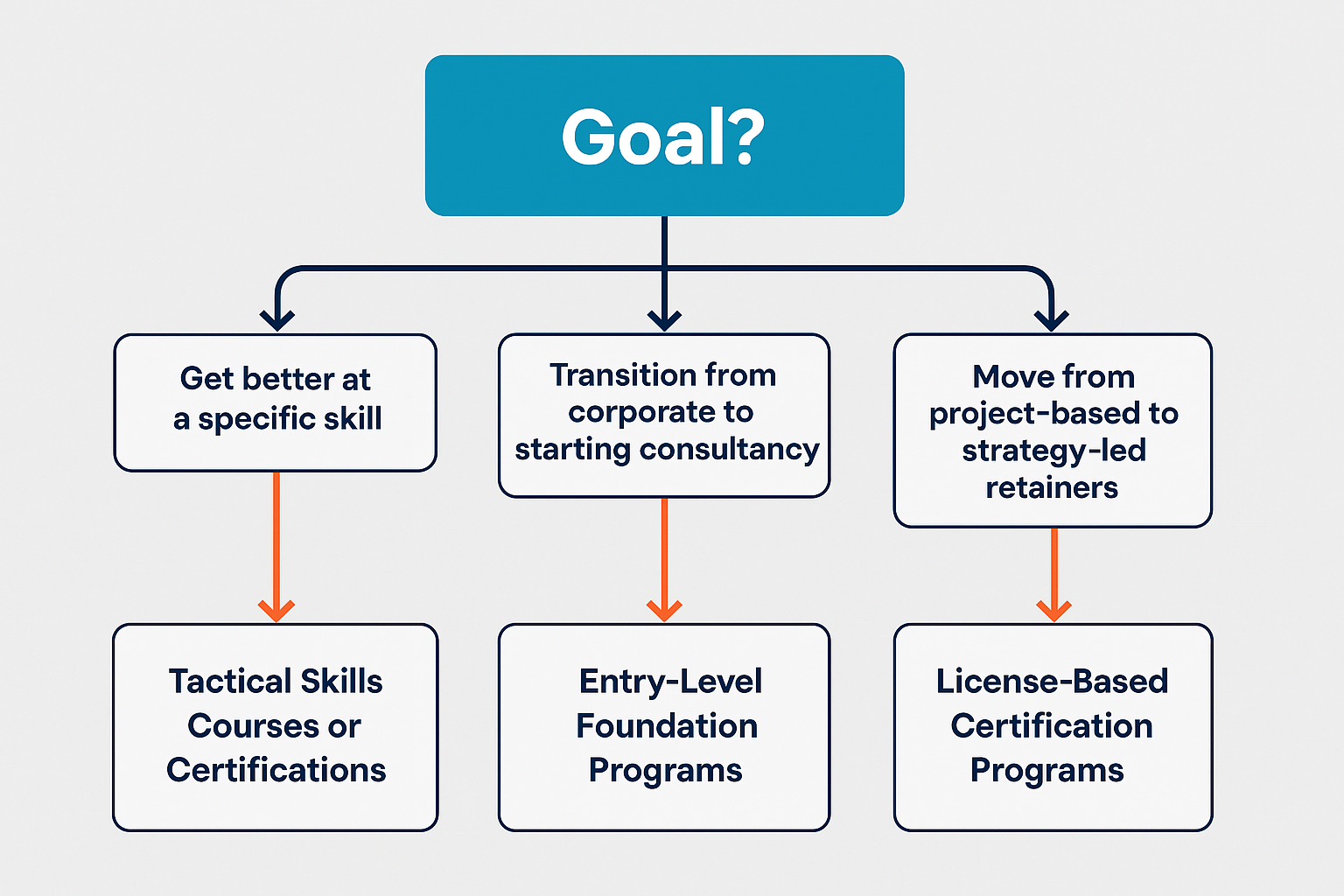
It’s time to get personal. Think about what you really want to achieve at this stage in your business or career. Are you looking to sharpen a specific skill set? Launch your own consultancy? Completely overhaul your agency’s business model? Different goals call for different solutions. Let’s explore a few typical scenarios and recommend the program type that tends to be the best fit for each, along with what to expect and key pros and cons.

Goal: “I want to get better at a specific skill.”

Scenario: You’re doing consulting or running an agency and want to sharpen one skill – like SEO, Google Ads, or copywriting – without overhauling your business.

Program: Tactical Skills Courses or Certifications

What to Expect: On-demand video lessons or short workshops that teach one topic step by step. Limited support – maybe forums or weekly Q&A.

Investment: Usually free to a few hundred dollars. Time commitment is light (a few hours to a few weeks).

Pros: Affordable, focused, and flexible. Great for filling knowledge gaps fast.

Cons: Narrow scope. Little business guidance or long-term support.

Takeaway: For a single skills upgrade, skip the big programs. A targeted course or certification gets the job done quickly and cheaply.

Goal: “I want to transition from corporate to starting my own consultancy.”

Scenario: You’re leaving a corporate marketing role and want to start your own consultancy or solo agency. You have the marketing skills, but not the business-building know-how.

Program: Entry-Level Foundation Programs

What to Expect: These 4–12 week programs teach basics like packaging services, setting pricing, and finding clients. Includes video lessons, group coaching, templates, and community support.

Investment: ~$500–$3,000 depending on format and coaching.

Pros: Saves time and helps avoid early mistakes. Built-in support and templates fast-track setup.

Cons: Covers broad basics, not deep dives. Quality varies.

Takeaway: If you’re going out on your own, start with a program that teaches business fundamentals – not just marketing.

Goal: “I want to move from project-based work to strategy-led retainers.”

Scenario: You’re doing one-off projects and want to offer long-term strategic services instead.

Program: License-Based Certification Programs

What to Expect: Intensive training in a strategy framework, plus tools and templates for client delivery. Ongoing support through coaching calls and a private network.

Investment: ~$5,000–$15,000, plus possible licensing or renewal fees.

Pros: Provides a proven system and confidence to sell strategy retainers. Includes ongoing support and tools.

Cons: High upfront cost. Requires full commitment to the framework.

Takeaway: To move into strategy-first retainers, invest in a framework that gives you structure, tools, and support to reposition your services.

Related Articles: 

Goal: “I want to scale my agency past $1M in revenue.”

Scenario: You’ve built a stable agency and want help breaking through growth ceilings like hiring, positioning, or systems.

Program: Agency Masterminds or Accelerators

What to Expect: Includes coaching, mastermind calls, strategic playbooks, and live events. Emphasis is on scaling operations, team, and leadership – not tactics.

Investment: ~$10,000–$50,000/year. May require travel and 12-month commitment.

Pros: Offers mentorship and peer accountability. Helps fast-track decisions and avoid trial-and-error.

Cons: Requires time, money, and focus to implement. Fit depends on group quality and stage alignment.

Takeaway: For established agencies ready to scale, a mastermind or accelerator provides the strategic support and peer insight needed to grow faster and smarter.

Related Articles: 

  • Marketing Leadership as a Service (MLaaS)

Goal: “I want to become a fractional CMO with a few high-ticket clients.”

Scenario: You want to serve a small number of clients in a part-time, high-level strategic role – without managing a big team.

Program: Fractional CMO Coaching or Strategy Certification

What to Expect: Focus on packaging your offer, pricing retainer engagements, and leading strategy. Delivered via coaching, peer groups, or system-based certifications.

Investment: ~$5,000–$15,000 for certifications; ~$800–$1,000/month for coaching programs.

Pros: Helps position and sell premium strategic services. Often includes support, templates, and community.

Cons: Not easily scalable beyond your time. May require personal brand building and network leverage.

Takeaway: If your goal is fewer, higher-paying clients and deep strategic work, a focused program will help you build and sell a compelling fractional CMO offer.

Related Articles: 

VIDEO: Are You Ready to Be a Fractional CMO?

Making Your Decision: Which Marketing Training Program is right for you?

Choosing the right program comes down to matching your goal and stage with the program’s purpose:

  • If you have a single skills gap, take a course or get a specific certification (no need to over-invest).
  • If you’re just starting out on your own, build your business fundamentals with an entry-level program or community – getting those basics right will pay off for years.
  • If you need to level up your service offering, especially to incorporate strategy and get recurring revenue, a certification or licensing program that provides a proven system can be a game-changer.
  • If you’re already established and aiming higher, a mastermind/accelerator can provide the mentorship and peer group to break through growth plateaus.
  • And for those pursuing a fractional CMO model, ensure you have a strategic framework and support system in place – whether through a certification or a peer coaching group – to help you successfully navigate that niche.

Finally, remember that no program is a magic bullet. Your results will depend on your effort. The best program in the world won’t help if you don’t do the work, and even a mediocre program can yield value if you actively apply yourself and extract insights. Before plunking down money, get clear on what exactly you want to get out of it, and how you’ll hold yourself accountable to use what you learn.

Choose the Right Marketing Certification for Long-Term Growth

The landscape of marketing certifications and training programs for consultants, agency owners, and fractional CMOs is more diverse and more valuable than ever. Whether you’re looking to master a tactical skill, adopt a proven client delivery system, or join a high-level agency mastermind, there’s a training option designed to meet your goals.

As you evaluate your next step, start with clarity: What problem are you trying to solve? The best ROI doesn’t come from the most expensive program, it comes from choosing the right one based on your business stage, growth targets, and service model. From lightweight online marketing courses to full-scale strategy certifications, every program type serves a purpose

Lastly, be strategic with your education investments, just as you are with your business. When in doubt, lean towards programs that emphasize strategy, systems, and support/network – those elements tend to deliver enduring value. (That might be a tiny hint from our perspective, as we strongly believe in strategy-first growth and comprehensive support, given our own experience in this space.)

We hope this breakdown has helped clarify the options and trade-offs. By understanding what’s out there and assessing where you want to go, you’re well on your way to making a smart decision. Here’s to your growth – whether that means mastering a new skill, signing better clients, or hitting that next revenue milestone, the right program is out there waiting to help you make it happen. Good luck, and happy learning!