Why Great Leaders Change Feelings Before Minds written by John Jantsch read more at Duct Tape Marketing
Catch The Full Episode
Overview
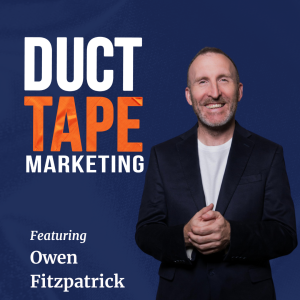 What does state propaganda have in common with the voice in your head telling you to play it safe? According to social psychologist Owen Fitzpatrick, more than you’d think. In this episode, Fitzpatrick joins John Jantsch to unpack the psychological machinery behind belief change, and why the same principles that drive nation-level propaganda campaigns also drive marketing, leadership, and personal transformation.
Fitzpatrick introduces a three-part framework for how beliefs actually form and shift: a belief has to feel right, it has to fit in with who a person believes they are, and only then does it need to make sense. Marketers and business leaders often jump straight to the logic and reasoning stage, missing the emotional and identity work that has to happen first. Fitzpatrick draws on examples ranging from Apple’s iconic ad campaigns to internal AI adoption struggles inside organizations to show how this plays out in practice.
This conversation is for marketers, business owners, and leaders who want to understand why logical arguments so often fail to change minds, and what to do instead. Fitzpatrick also draws a clear line between ethical influence and manipulation, offering a useful lens for anyone in the business of persuasion.
Guest Bio
Owen Fitzpatrick is a social psychologist, keynote speaker, and author of nine books translated into more than twenty languages. He has worked with leaders at organizations including Google, LinkedIn, Pfizer, Coca-Cola, Morgan Stanley, and Citibank, and has studied propaganda firsthand in North Korea, Rwanda, and Afghanistan. His newest book, Inner Propaganda: Leading Hearts and Minds Through Turbulent Times, explores the psychological forces that shape belief formation in individuals, organizations, and nations.
Key Takeaways
- Beliefs form through three gates in order: feels right, fits in, makes sense. Logic is the last gate, not the first.
- Affective realism means people perceive reality through the lens of whatever they’re feeling in the moment, which shapes what they notice and remember.
- Strong brands work because they connect to identity. People buy products that reflect who they are or who they want to become.
- Ethical influence focuses on what the other person genuinely wants and is honest about intent. Manipulation relies on deception regardless of what the other person wants.
- Resistance to change, including AI adoption, often comes from psychological reactance. People push back when their autonomy feels threatened, not necessarily because the idea itself is wrong.
- Leaders get more buy-in when they help people see who they can become in a new scenario, rather than just presenting the logical case for change.
Great Moments
- [00:01] – The propaganda-versus-personal-beliefs framing that opens the episode
- [01:12] – Fitzpatrick shares the personal story behind the question that changed his life
- [03:40] – Introduction of the feels right, fits in, makes sense framework
- [06:27] – The Apple and identity-based buying example
- [07:36] – Drawing the line between influence and manipulation
- [10:51] – Why teams say yes to a plan while not actually believing in it
- [14:19] – The staff member who went from hating AI to mastering it
- [20:01] – Revisiting the classic Mac versus PC ad campaign
- [21:00] – The Old Spice commercial as an identity-driven marketing example
Memorable Quotes
- “People don’t follow plans, they follow beliefs.” – Owen Fitzpatrick
- “Being right is not enough. If you want it to be successful and it to work, you need to make it feel right.” – Owen Fitzpatrick
- “The stories that you sell to yourselves become the beliefs that you buy into.” – Owen Fitzpatrick
- “Influence is about figuring out what is it that they want and is good for them, and how can we connect the dots to what is it that I want them to do.” – Owen Fitzpatrick
Resources
- Inner Propaganda: Leading Hearts and Minds Through Turbulent Times (book): innerpropaganda.com
- Owen Fitzpatrick’s website: owenfitzpatrick.com
John Jantsch (00:01.976)
So, what if the voice in your head telling you to pull back, play it safe, or try the strategy that didn’t work last time is running the same playbook as a state propaganda agency? Hello, and welcome to another episode of the Duct Tape Marketing Podcast. This is John Jantsch. My guest today is Owen Fitzpatrick. He’s a social psychologist, keynote speaker, and the author of nine books, translated into more than 20 languages. He’s worked with leaders at Google, LinkedIn, Pfizer, Coca-Cola, Morgan Stanley, and Citibank.
Across more than thirty countries, and he studied propaganda firsthand in North Korea, Rwanda, and Afghanistan. We’re gonna talk about his newest book today, Inner Propaganda, leading hearts and minds through turbulent times. So, Owen, welcome to the show.
Owen Fitzpatrick (00:48.985)
Thank you so much, John. Real pleasure to be here.
John Jantsch (00:51.502)
So you write about time when you were fourteen years old, that you wrote a suicide note. you say the one question changed the story you were believing in that moment. So looking back now, with everything you know about all the beliefs, of how beliefs I should say actually work, what do you think happened psychologically?
Owen Fitzpatrick (01:12.323)
So from a psychology point of view, I think what happened was my brain asked a question, and I’m still not to this day sure where that question came from, but wherever it came from, the question I asked myself to help me to look at things differently so that I felt differently about the situation. So always we talk about the importance of persuading people and using logic and reasoning. And anyone in marketing will obviously know that the most important element of being able to convince people is largely about the way in which we make people feel.
So the ability that we have to create a feeling in the other person will not just determine how they feel about the product, it will also dictate how they think about and what they believe about it as well. So the question I asked myself was, and this was when I was in the middle of writing the suicide note where I was looking to end my life, I was I I I basically apologized to my parents and I said, I’m sorry that I have to do this, I just can’t see any other way. but I love you so, so much.
And then the question that I asked was, Is this how much you love them? And that question was so powerful because it almost like in a cynical way forced me to imagine what I was doing to them. And it changed the feelings that I felt at this moment. And so it wasn’t the fact that I loved them that saved me because lots of people end their lives and they love the people and the people love them. But it’s the fact that it drew my attention and it caused me to feel.
quite strongly that there’s no way I could do this. And I think in many ways it changed my belief in that moment from believing I needed to die to believing I needed to live. And I think all my life, that’s what I’ve been searching for. All those journeys to, you know, or countries like North Korea, all the work I’ve done from a corporate perspective as a therapist when I work with thousands of clients, it’s always been working on this notion of how do you help a person to change beliefs? And I believe fundamentally we need to look at it from three gates that we go through.
The belief has to feel right. It has to fit in with who the person is. And only then will it make sense. And I think that most of the time when we try to persuade ourselves or others, we fall into the trap of just trying to make it make sense using logical reasoning. But that’s the last gate to enter. It’s table stakes, but it’s not the most important. And I think that’s the message I’m trying to get out with the book.
John Jantsch (03:30.475)
Yeah, so walk through that framework. feels right, fits in, makes sense. that’s that’s really the central premise of of the entire book or framework of the book. So walk us through that a little bit.
Owen Fitzpatrick (03:32.469)
Mm.
Owen Fitzpatrick (03:40.954)
Sure. So there’s a concept in psychology or neuroscience called affective realism, which basically means that the way in which we perceive reality is through the lens of the feeling we’re feeling. So if you’ve ever felt hangry, that means hungry b you know, hungry and therefore you’re angry or tangry, that means you snap at people and you’re angry when you’re tired. Those experiences that you feel actually dictate how you respond or how you take in the world. So when you’re hangry or tangry, often you don’t even notice it. You just see the world in that angry way.
And the problem is that because our feelings play such a big part in determining our reality, we can walk away from a situation having experienced a particular situation in a specific way based on how we feel. So when we feel anxious, we tend to see the world through that anxious lens. There’s a c another concept called mood congruent cognition, which means we’re more easily able to remember situations which is associated with the feeling we’re feeling. So when we’re depressed, we’re more likely to remember negative events in the past.
We’re more likely to imagine negative experiences in the future. And so our brains, based on how we feel, determine where our focus lies. And it’s almost like our brains are like a news station, right? A news channel. Just like a news channel will A, select it. Like if you watch Fox versus you watch CNN, you’ve got they’re both selecting totally different facts or totally different data points to report the news on, number one.
John Jantsch (05:00.365)
Totally different tot totally different alternate facts, but go ahead, yes.
Owen Fitzpatrick (05:04.95)
yes, yes, yeah. And and and also different worlds, right? But you look at CNN, you look at Fox News, they will paint a picture of whatever they’ve selected at that moment, and they’ll also then engineer a narrative about it, what I call truth engineering. So they’ll engineer a narrative about both. And so what you have is you’ve got two different news channels based upon their agendas, creating two totally different realities, two totally different worlds. Now, if you bring that to the brain, the brain does the exact same thing. You experience the world.
And your brain, based on how you feel, will dictate what you pay attention to in that moment. And also, whatever you are paying attention to, it’ll engineer a narrative or story. And the stories that you sell to yourselves become the beliefs that you buy into. And so what’s really critical is we start to recognize this process. And so it starts with feelings. Then the second piece is what I call fits in, which is really about internal indoctrination. It’s that we won’t accept a belief unless it fits in with who we believe we are.
And again, from a marketing standpoint, if you were trying to sell to someone, the reason I buy Apple products is because they’ve convinced me that I’m the kind of person that needs to buy Apple products, right? If Apple were releasing an apple for $200, I’d probably go, I want to get one of those. I’m the kind of person that eats $200 apples, right? Because they have created a brand so strong that my identity is locked to it. And sometimes it’s not even who I believe I am, sometimes it’s who I want to be in that moment. But it’s
John Jantsch (06:24.471)
Yeah, yeah, yeah. This this’ll make me cooler. Yeah.
Owen Fitzpatrick (06:27.181)
Exactly. If I buy these you know, these these sneakers, this will allow me to jump as high as Michael Jordan. Like this is the mentality that we’ve built over the time. And when we want to change beliefs, if we if we truly want to be able to get a person to see things differently and have a different belief system about something, we need to number one make sure it feels right to them. Number two, it needs to fit in with who they are. And then we can give the logical reasoning, then we can give the benefits, then we can overcome the objections, then we can do all the w work of logic.
John Jantsch (06:30.637)
Right.
Mm-hmm.
Owen Fitzpatrick (06:56.557)
But these first two gates are the things that a lot of people miss out on. And I think people in in terms of the field of marketing have a bit of an advantage because they do, based on my market research, they realize how powerful emotions are. But I think when we put it together in that sequence, it gets a lot better results than we do when we just try to push forward with the traditional, here’s the reasons why you should buy my product.
John Jantsch (07:17.857)
You know, a anytime marketers, business people start talking about influence and psychology, particularly, i is there a manipulative element to this? Like if I understand that that’s all I have to do is turn these dials on you, then I know you’re gonna believe whatever I say. I mean, isn’t that a little bit of what propaganda does?
Owen Fitzpatrick (07:36.15)
In many ways, yes. I mean, influence, if we take influence propaganda, manipulation, let’s let’s clarify the term. So influence is when you’re able to communicate in a way that you impact the decisions or the attitude or the perspective or the beliefs or the feelings of the other person, right? manipulation is when you deliberately deceive the other person so that you can get them to do exactly what you want. And I I always clarify the difference between the two is ethical influence.
is about figuring out what the other person wants, understanding what you want and learning to connect the dots. So
John Jantsch (08:08.885)
And it also and and it might be good for them, right? Yeah. Yeah. Yeah.
Owen Fitzpatrick (08:11.585)
Yes. Because you’re yeah, yeah, very good point. But what you’re trying to do is you’re trying to engineer it so that you’re getting them what they want. And what they want is not always something tangible. Sometimes what they want is a feeling, right? So you’re providing that feeling through the product that you’re selling. It’s perceived value, which becomes real value because they experience it that way. And then the second piece is the use of deception. So manipulation is when you you you know, you’re more likely to use deception, whereas
when we’re honestly ethically influencing someone, we’re not lying about anything. We’re not e you know, we’re not deceiving them in any way, shape, or form. And so to me, influence is about figuring out what is it that they want and is good for them, to your point. and how can we connect the dots to what is it that I want them to do? And then second of all, how can I do this in an honest way? Because manipulation is I don’t care what you want. I’m gonna do whatever I can to to make you know or believe or feel what I want you to feel. And if we take propaganda.
Generally, that’s the state’s attempt to manipulate the way in which we feel. But you could also argue that almost everything is propaganda. Like when when when back a few hundred years ago, the first term propaganda was used in a in a benevolent way from the Pope, where he was trying to propagate or spread the news of of of the church. and that got obviously turned very dark when Yusuf Goebbels in in the 1930s was
John Jantsch (09:28.983)
Yeah. All right.
Owen Fitzpatrick (09:38.166)
minister for propaganda and then you know what happened there. But I think what’s really important to realize is that every organization out there, leadership effectively becomes a form of propaganda because you’re trying to organize and tell the story of how things work to your people. Marketing is certainly a form of propaganda because you’re trying to win the story war in the customer’s mind. And so recognizing it’s not necessarily seeing it as a nefarious or negative thing, but seeing
John Jantsch (09:40.972)
Yeah, yeah, yeah.
Owen Fitzpatrick (10:05.945)
Propaganda is this is how we control the perception of things and understanding it’s what we do to ourselves all the time gives us an advantage in terms of understanding how we can do this in a good ethical way to make a positive difference to the folks we we’re marketing to.
John Jantsch (10:21.259)
Well, and and even inside of organizations, a lot of times the leader who has the vision, you know, needs to get everybody to understand and believe in the vision. And I I I’m sure a lot of folks that are listening today have had the experience of, I don’t know, maybe they went to a conference and they came back and said and said, Here’s what we need to do. We need to change the business and start doing X, Y, and Z and then watching the team just go, I I don’t get it. you know, is based on your framework. where’s the breakdown in that type of scenario?
Owen Fitzpatrick (10:51.523)
So I I think the problem isn’t that the team will go, we don’t get it. I think the problem is the team will go, yeah, we get it, but not actually believe in it. Right. We all know what it’s like, John, when someone goes, yes, and we know there’s zero chance of it happening. To me, that’s the problem. And so the reason the framework works so well is because we’re not giving them like that what what the leader’s doing in that case is they’re making sense. They learn something, then they come back and go, here’s what we need to do. We need to to change everything, and now we need to use AI.
John Jantsch (10:59.381)
Yeah, yeah, yeah.
Owen Fitzpatrick (11:19.853)
Just AI. I want everyone to get on board. AI is going to be great for this organization, right? Let’s do it. Here’s how we’re going to do it. Here’s the plan. Here’s the strategy. People don’t follow plans, they follow beliefs. So all of these people are sitting there going, so what I’m getting from you is you went to some fancy conference, you came back, you want all of us to get on the AI train where we know that the AI train is going to cost us our jobs. So you want us to buy into this? Sure, we’ll say yes, but there’s no chance of that happening. And so the leader in that case.
Is losing them because he’s not focusing on making it feel right. So if he wanted to, he or she wanted to make it feel right, then the strategy would be well, what is it that what is it, what are the emotional reasons why this would be something good for them? That’s number one. So what is it that we could that I could do to make them feel good about this opportunity? And number two, it’s just as important, who are they in a new AI world? Because if I’m a coder and you come back to me, John, let’s say I work for you and you say, Hey, Owen.
you know, I want you to be using AI more, we need to scale more, we need to use it more. If AI is doing the coding and I’m a coder, what am I now? Because now I’ve lost my identity because AI is doing my job for me. So what value do I even bring? And I think we forget that. We think here’s the logical reasons why you should want to use AI, but we’re not actually changing the way people feel and connecting it to who their identity is. So in that context, again, the leader should be thinking, how can I create or help them create?
An identity for them to move towards where they can see themselves thriving in a new AI world. And when you’re able to do that as a leader, when your vision isn’t just about your company doing well using AI, but it’s a a a vision which identifies how amazing it will be for your team and who they will become, that’s also gonna make it feel right. And then all of the plans or strategies you have around that, now all of a sudden you you go from compliance.
which you don’t really want as much as buy in, which you do want. And that moves towards commitment and conviction, which is the ultimate North Star you’re going for. That’s how I can I suppose look at those kind of mistakes we make and how feels right fits in and makes sense would actually make the most sense because it feels right and because it fits in with who they are.
John Jantsch (13:28.651)
I think that’s a great example because a lot of people are experiencing that right now. the you know, the AI adoption. What’s interesting that I have noticed is that there is a segment of pretty much everybody’s business that if feels right, fits in and makes sense. and then there and then you have a lot of people that are very threatened by it. And I think it’s that fits in. Well, maybe it starts with feels right, but it certainly hits the fits in box or hot button for them or doesn’t fit in.
So how do you I mean, so I’m sure a lot of business owners are struggling with this idea of you’re absolutely right. We that we need to educate more, we need to s figure out what’s in it for them. But then you have this part of your team that’s just taking and running with it. so you know, how do you kind of balance the whole the fact that people have different beliefs?
Owen Fitzpatrick (14:19.321)
So I think when you deal with someone who’s already taken and running from it, the reason they’re doing that is because before you even opened your mouth, for them, it already felt right. They’d they’ve already be feeling good about it. It already fit in with who they are and it already makes sense. I’ll give you an example. I I hired you know, a member of my staff who initially they’d done some part time work for me. And when they came on board, one of the things they said to me was, AI, I hate it. It it it caused me to lose my job the last time.
John Jantsch (14:27.819)
Right. Yeah.
That’s right.
Owen Fitzpatrick (14:48.961)
I do not want to ever have that happen again. And so what I did was I I got them to go in and I said, look, what I need you to do is I need you to make it so that you understand everything you can about AI. So for the first month, it was just them immersing themselves in that. And as they did that, I knew that as they did that, as that was their entire goal, it wasn’t I want you to use AI to do this for me. I was like, I want you to become a master so you know exactly what to what tools to use in what ways. They came back after a month and they were like a ninja. They could do anything.
John Jantsch (15:03.147)
Mm-hmm.
Owen Fitzpatrick (15:17.759)
And more than that, and more way more important, they started to see themselves as the kind of person that was amazing in in using AI. And so the main trick that I I feel is in order to make something feel right, and we’ll we’ll just give another example in the AI, there’s a psychological concept called psychological reactance, which is that whenever my autonomy is taken away from me, I’m gonna push back, I’m gonna demonstrate more resistance. Now, if you’re trying to create any form of change in an organization, one of the most important things is.
Is that let people feel like they’re a part of the change. Don’t just tell them, hey, by the way, John, you are changing. Here’s what we’re gonna do from now on. You know, I’ve just been to a it well, here’s the thing: it’s faster, but how good is speed when it doesn’t work, right? So you know, even if it’s faster, it still doesn’t get the job done. What does get the job done is to pull back and go, hey, listen, we’d love to invite you and let’s have a conversation.
John Jantsch (15:53.325)
Yeah, but that’s so much easier and so much faster. In the short term, right? Yeah, yeah, yeah, yeah.
Owen Fitzpatrick (16:10.701)
And the more you let them speak and communicate, the more you ask questions, the more you build curiosity in that way, and the more you then show examples of the possibilities, the more likely they are to come on board because there’s less reactants there. You’re not pushing them, you’re having conversations with them. And that to me allows them to get to the point where it starts to feel right. Cause before it feels right, it needs to not feel wrong. And it feels wrong when it’s pushed on me. It feels wrong when it’s in direct conflict to who I see myself as being.
John Jantsch (16:35.031)
Yeah, yeah.
Owen Fitzpatrick (16:38.475)
It feels wrong when it’s scary to me. It feels wrong when it might be taking over my job. And so those are the things we need to focus on first. How do we stop it from feeling wrong? And then how do we help it feel right? And that requires having conversations, which to your point, John, it’s like, why should I have to? There’s lots of stuff we should have to shouldn’t have to do, but being right is not enough. If you want to it to be successful and it to work, you need to make it feel right.
John Jantsch (17:03.895)
So we we’ve talked about the it it in your intro and certainly your your book deals with this idea of of belief systems in places like n you know, North Korea and corporate boardrooms in your own life. is the machinery in those settings different or are we talking about the same thing across all these contexts?
Owen Fitzpatrick (17:27.097)
Pretty much the same. I mean, we can generalize all day long and we can say this is the same and we can find nuanced differences, but ultimately the way in which the human brain is built is based upon the needs that our brains have. And our brains fundamentally have two primary needs the need for survival and the need for stability. The brain needs to survive, therefore, it will often have what we call a negativity bias as well as a drama bias. The negativity bias means we’re oriented to spend more time focusing on what we have to lose. And that’s obviously what every
John Jantsch (17:30.604)
Yeah.
Owen Fitzpatrick (17:56.056)
Marketing professional will know is that if you focus on the problems and the pain points, often that will get you a lot of traction. And then also it’s dramatization. So the brain also needs to notice what’s a bigger deal than something else. So therefore, that’s the hyperbole that’s used often in terms of the news to get people’s attention. Once more, the more you hype it up, the more likely people are to pay attention. But the other piece is also important, and it’s important as well from a marketing standpoint, as well as from a mental health standpoint, as well as from a leadership standpoint. If I’m in a situation where
I’m trying to achieve a particular result and trying to persuade people, I have to know that the brain needs stability, which means it likes coherent stories that are simple to understand, which requires as little energy from my brain as possible. So that’s why politics works so well dividing us, is because it’s very simple to sell an idea that says, we good, they bad, us good, them bad, and repeating that over and over again by giving examples where we’re good and where they’re bad.
In the marketing world, that’s what we’re what what they’re doing. They’re ultimately speaking, taking this theory, this message, and they’re using very sophisticated messaging to continuously engineer the way in which people feel. I feel good about me and my tribe, and I feel bad about them. And this is etched into the way in which we think. We are tribal in terms of our mentality. We have you know, in the hunter-gatherer days, we needed to be part of a tribe in order to stay safe. So it’s very easy to get us.
to seduce us into seeing it and often believing a certain belief is the membership fee you pay in order to become part of that group. And so if from a you know influence perspective, you understand about that identity, you understand about the feelings, then it’s much easier for you to be very effective. So it happens in politics, it happens in marketing, it happens in leadership. And even in our own mental health, we tend to be dominated by our feelings, which dictate like I talked about earlier, what we’re focusing on.
John Jantsch (19:42.337)
Yes.
Owen Fitzpatrick (19:51.118)
And as a result of that, the same engineering that’s taking place in our brain is taking place in these huge nations that have been operating propaganda campaigns for for for so long.
John Jantsch (20:01.803)
Yeah, and it would be too easy to show some examples of current politics, us against them. so I’ll revert back to one of my favorite ad campaigns that Apple ran. you know, you had the guy the two the guy in the stodgy suit, you know, that was that was that was the PC and the hip cool guy that wore tennis shoes to work, you know, was the Mac. Like, here’s the enemy. You you don’t wanna be like them, do you?
Owen Fitzpatrick (20:17.197)
Yeah, yeah, yeah. I’m a Mac, I’m a PC.
Owen Fitzpatrick (20:29.579)
yeah.
John Jantsch (20:29.694)
it wasn’t quite as overt, but certainly that was the message, wasn’t it?
Owen Fitzpatrick (20:32.727)
It was that was one of the most phenomenal pieces of marketing. I h 100% agree. And what I loved about it was, you know, sometimes the the PC would be like, and then the other, you know what I mean, continuously freezing. And everything about it was just the identity piece. It was like, who do you want to exactly what you just said there, John, who do you want to be? And I think when when we see this in action, we don’t realize that this is something that from a marketing standpoint, the very best do, even if you’re a member.
John Jantsch (20:42.317)
Yeah, yeah. Yeah.
Owen Fitzpatrick (21:00.147)
there’s that ad of, you know, look at me, now look at him. It was the it was the old spice commercials with the guy who’s, you know, it was like, look at your man, now look at me. He could be like me too. And that whole that blew up, and that was one of the most successful commercials of all time and millions upon millions of views. But once again, it did so because it was very powerful from an emotional standpoint, and it also had an idea identity component. And so many of the purchases, particularly around you know.
John Jantsch (21:07.402)
yeah.
John Jantsch (21:10.657)
Yeah.
Owen Fitzpatrick (21:29.609)
hygiene or particularly around what we wear are all oriented towards who do you want to become? What kind of person do you want to be? And I think this is something that from a marketing standpoint, the greatest legends in the marketing world all intuitively understand that. So what I’m trying to do is help people to understand this is what’s happening inside our head. And the more we understand the inner propaganda which is in all of our heads, that is all convincing ourselves of certain things,
John Jantsch (21:35.287)
Yeah. Yeah.
Owen Fitzpatrick (21:56.046)
The more we realize that for me to influence someone else, I need to make sure that the ideas I present feel right, fit in with who they are. And only then will it make sense because that’s what’s going to get through to their inner propaganda. Otherwise, the objections which are formed from the beliefs of their own inner propaganda will prevent them from ever doing business with us. And that’s kind of the core message that I’m trying to put across.
John Jantsch (22:18.093)
Awesome. Well I appreciate you taking a few moments to stop by own. is there some place you’d invite people to find out more about your work and obviously your book?
Owen Fitzpatrick (22:25.059)
Sure, absolutely. So there’s innerpropaganda.com is where you can go. More information about the book. I’ve got endorsements. I was lucky enough to get endorsements from the likes of Robert Cialdini and Jonah Berger and Tony Robbins and whatnot and Daniel Pink. so there’s more information there. You can also put in your details once you bought the book and get a free masterclass with me in a free workbook. And I’ve also my website, ownfitzpatrick.com, and I’m on most social media. I have a podcast called Inner Propaganda Newsletter too. So innerpropaganda.com or ownfitzpatrick dot com.
John Jantsch (22:55.433)
Awesome. Well again, I appreciate you stopping by the Duct Tape Marketing Podcast and hopefully we’ll renate to you one of these days out there on the road.
Owen Fitzpatrick (23:01.518)
Thank you so much, Sean. My pleasure.
Sign up to receive email updates
Enter your name and email address below and I’ll send you periodic updates about the podcast.