Author Archives: Trafficblast

Bridging the Courage Gap in Your Business

Bridging the Courage Gap in Your Business written by Jarret Redding read more at Duct Tape Marketing

The Duct Tape Marketing Podcast with Margie Warrell

In this episode of the Duct Tape Marketing Podcast, I interviewed Dr. Margie Warrell, bestselling author, leadership coach, and global authority on courage and risk-taking. We unpacked the core ideas from her latest book The Courage Gap: Five Steps to Braver Action—a must-read for anyone navigating the often uncomfortable decisions that come with running a business.

From Fortune 500 boardrooms to small consulting firms, Margie has helped leaders overcome fear, self-doubt, and the imposter syndrome that hold them back from realizing their full potential. Our conversation explored the emotional triggers that prevent entrepreneurs from raising their rates, making bold decisions, or having tough conversations. Her advice? Business courage isn’t about fearlessness—it’s about action in the presence of fear. Whether you’re a solo entrepreneur or leading a team, closing the courage gap could be the difference between surviving and thriving.

Dr. Margie Warrell’s insights offer an actionable framework for overcoming fear, boosting your entrepreneur mindset, and leading with integrity. Bridging the courage gap could be your most powerful strategy for small business growth.

Key Takeaways:

  • The Courage Gap Is Real: The space between what you know you should do and what you actually do is often filled with fear and hesitation—not a lack of knowledge.
  • Bravery in Leadership Starts Small: Margie emphasizes that courage is like a muscle. Daily habits like journaling, exercising, and intentional pauses help strengthen it.
  • Pause or Procrastination?: Learn to distinguish between a strategic pause and fear-based delay. Clarity leads to action.
  • Imposter Syndrome Affects Everyone: While female entrepreneurs often face a unique set of challenges, courage gaps affect all leaders—especially when it comes to pricing strategy and self-worth.
  • Raise Your Rates With Confidence: Stop questioning your value. Consider what your service is worth to them, not just what you feel comfortable charging.
  • Move Through the Unknown: Waiting for certainty leads to stagnation. Small, courageous steps build momentum and inform your next best move.

Chapters:

  • [00:09] Introduction to Margie Warrell
  • [01:01] What is the Courage Gap?
  • [02:57] The Difference Between Fear-based and Strategic Pausing
  • [05:06] What Role Does Imposter Sydrone Play?
  • [09:48] Finding the Courage to Charge Your Worth
  • [12:15] Habits to Build Courage
  • [14:35] Dealing with Fear of Rejection
  • [17:10] Being Couragous Through the Unknown

More About Margie Warrell: 

  • Check out Margie Warrell’s Website
  • Connect with Margie Warrell on LinkedIn

John Jantsch (00:00.92)

Hello and welcome to another episode of the Duct Tape Marketing Podcast. This is John Jantsch. My guest today is Margie Warrell. From the outback Australia to Fortune 500 boardrooms, and the US Congress, Dr. Margie Warrell is a global authority on leadership, courage and navigating risk. Bestselling author, speaker and coach, she empowers people to make bold decisions. She’s also the host of a show like this called The Live Brave Live.

There go. I’ll get it right. Live brave podcast. We’re going to talk about her sixth book today, the courage gap, five steps to braver action. So Margie, welcome to the show. So are you living in Australia? No, you can’t be. It would.

Margie Warrell (00:38.333)

Great to be with you, John.

Margie Warrell (00:43.038)

No, I am living on the same terra firma as you. I actually live just south of Washington DC, in North Virginia.

John Jantsch (00:50.711)

Okay, I was gonna say it would be a terrible hour to be doing a podcast in Australia right now. Yes. So let’s start with the with the title of the book, The Courage Gap. What is it?

Margie Warrell (00:53.696)

It would, 5 a.m.

Margie Warrell (01:04.804)

Yeah, well, John, have you ever had one of those times where you knew there was something you should do? Like you knew you needed to have a conversation, you knew you needed to make a change and you needed to move someone out of a role or and yet you held back and you hesitated and you procrastinated and you rationalized and I can see you nodding. Well, you know, it is not a lack of knowledge that creates that gap between

John Jantsch (01:24.494)

Yeah, of course. Who has it?

Margie Warrell (01:32.936)

between what we should do and what we do. It is a lack of courage and that gap is widened by our fear. What will happen? What if this person gets upset? What if I mess it up? What if I lose money? What if I get it wrong? What if it’s really ugly and awkward and there’s a huge fallout? What will people say? What if I fail? And so our fear creates the gap between the actions we’re entirely capable of taking, holding someone to account.

you know, getting rid of someone out of your business because they’re not a fit, et cetera. Having a difficult conversation with your co-owner and what we actually do. And it takes courage to close that gap. But as I make the case at the start of the book, when we fail to take those risks, to make the change, take the chance, speak up, et cetera, we actually become more vulnerable to worse outcomes over time.

So the discomfort we’re trying to save ourselves, the thing we’re trying to avoid, we actually end up suffering way more over time and end up in a worse place. And it’s why, John, that most people, when I speak to them and I do a lot of speaking and run programs, and I’ll say, hey, who here can sometimes regret that they took too long to do a difficult thing? And most people go, yep, yep, yep.

John Jantsch (02:54.766)

Yeah. You know, I’ve, I’ve actually been in business 30 years. And so a couple of things I’ve learned over the years is every now and then you like go through that fear and you do the thing. And actually what happened was way less worse than you thought it was going to be right. And you, start banking that, but then there are also been times when I’ve paused and that was the right thing to do too. So how do you kind of like, how do you differentiate between fear-based procrastination and a strategic pause?

Margie Warrell (03:24.198)

Yeah, well, I think a pause can be very wise. That is just before plowing forward, stepping back, just re-grounding for a moment in like, okay, what’s going on here? Where are my emotions getting away with me? And I think recognizing there’s a difference between being brave and courageous and being reckless and foolhardy and impulsive and reactive.

I’m talking about considered action. And I think what you’re saying is that sometimes procrastination, but I would call it not procrastination. You’re not, know, oh, it’s all too hard. It’s actually saying, I’m just gonna just stop for a moment and consider things thoughtfully. I’m gonna try and get the emotions out of this. And as objectively as I can, think through the pros and cons short term and

far term of different courses of action and align with my values. What feels right for me? What has integrity here? What aligns with the kind of person, leader, business owner I want to be? Okay, now I’m going to move forward. And so there is a distinct difference. And I think practicing a pause is a lot of power in a pause. And I actually think that when we can stop the busy doing, doing, doing,

John Jantsch (04:46.296)

Yeah, yeah.

Margie Warrell (04:51.072)

and reconnect to who we’re being, which let’s face it, a lot of business owners really do. It actually high grades the actions we take. It’s like, ah, this is what I need to do. It actually can help us be way more effective than just sometimes scurrying furiously and going in circles.

John Jantsch (05:08.327)

So I’m going to probably wade into dangerous territory here. We’re going to talk about courage, you’re right. Is there a difference in this gap, real or perceived, between men and women? I’m a white male born in America. I think I’m entitled to everything. So why would I have imposter syndrome, right? I’m being somewhat facetious, but not.

Margie Warrell (05:11.774)

Okay, let’s go. Let’s go. And we’re talking about courage.

you

Margie Warrell (05:24.008)

Yes.

John Jantsch (05:37.038)

Is it much harder, say, for a woman to particularly, or somebody who doesn’t have the advantages that feels like that imposter syndrome is because they’re like, do I belong here?

Margie Warrell (05:51.838)

Yes, there is absolutely a difference, gendered difference in our experience of our circumstances, of ourselves, of our ability to navigate risk, what might feel risky. And let me just start by saying that this concept of courage, one, yes, it’s a trait. Some people naturally come out of the womb with just a higher tolerance for risk.

John Jantsch (06:09.934)

Mm-hmm.

Margie Warrell (06:20.464)

than others. And yes, there’s even there’s a gender element to that too. You know, I think of my sons like, Mom, look, no hands riding their bike down a hill and my daughter never did that. But yes, I mean, I’m generalizing, but I think there’s some truth to that. Men like sticking out at high adrenaline activities more so than women. So I think part of that might be nature, part of it nurture, we’re not going to debate that. But recognizing courage isn’t just choosing to take action in the presence of fear.

It is also the management of our fear. And often we have more fear than we need to have. So we have this magnified perception of risk. I could never do that. my God, that would be just terrifying. And actually you can do it. And it’s as only as terrifying as you’re making it to be like to start a business, to expand into a new market, to…

John Jantsch (06:55.926)

Mm-hmm.

John Jantsch (07:07.79)

you

Margie Warrell (07:12.34)

hold someone accountable, et cetera. And as you said before, sometimes we lay awake in bed, I’ll let this person go, I gotta hold them accountable. And then we do it, go, it wasn’t that hard, I should have just done it. But for women, and speaking as a woman, and I grew up in Australia, where I think there’s also a cultural difference in Australia as well to the USA, but I think women, partially because of our social conditioning, do struggle more with self-doubt.

Do second guess themselves more. not often not feel as confident to put themselves out there to just try something and wing it. I’ve seen a lot of men going, hey, let’s just try this. I don’t know quite what I’m doing, but I’ll just wing it and I’ll fumble through and I’ll mess up a few times. And when I do, I’ll just go, yeah, whatever, learn something, move on. Women, we ruminate, we second guess, we beat ourselves up when we don’t do things perfectly.

John Jantsch (07:40.94)

Mm-hmm.

John Jantsch (07:57.846)

you

John Jantsch (08:06.562)

Well, or let’s let’s be honest, sometimes you don’t get a second chance. You know, where is just what you said, you know, so there’s this fear of like, can’t screw up.

Margie Warrell (08:11.497)

and s-

Margie Warrell (08:15.816)

Yeah, and that’s true. Women are judged more harshly when they don’t get things right. You know, we know with the glass cliff phenomena, etc. But I also think as women, we can sometimes unwittingly internalize misogyny. Like we are biased against ourselves. We judge ourselves more harshly. We also judge other women more harshly. This is actually backed by a lot of data. Women are harder on other women.

John Jantsch (08:36.994)

Interesting.

Margie Warrell (08:45.542)

So there was a great experiment out of Columbia, the Heidi Howard experiment, where they were looking at the CVs, they were exactly the same. And some of them were titled Heidi and some of them were titled Howard, exact same words. And when people were looking at it, would you want to employ this one or this one? And they were described as being ambitious and competitive. When it was Howard, like, yeah, he sounds like a good guy to have on the team. When it was Heidi, it’s like, I don’t want to have her, ambitious and competitive. So just recognizing we can be hard on ourselves.

And so I think I have done a lot of work with women, business owners, women leaders, entrepreneurs over the years. And I wrote about this in my prior book called, You’ve Got This. I’ve had to say so many times, you’ve got this, go for it, back yourself, take the risk. Don’t wait until you know exactly what you’re doing. Do not wait until you are 100 % confident, just do it and give yourself permission to figure it out as you go along.

And I really have to, I don’t have to say that as much to men.

John Jantsch (09:46.594)

Yeah, yeah. Well, I’m glad we went there. Obviously, that was a little off topic. No, no, no, no.

Margie Warrell (09:49.376)

And that’s not critical, by the way, that is not critical of men. I’m often like, just do more of what he does because hey, it’s working for him.

John Jantsch (09:58.476)

Yeah. Yeah. Yeah. So, so let me, let me, let me go straight to a topic I hear all the time. I mean, very specific, courage gap. I work with a lot of marketing consultants, marketing agencies. We, do training, we license our methodologies to them. And one of the things I have to work on the most right from the beginning is getting them to understand they need to raise their prices. and that’s one that a lot of businesses, you know, they sit in front of a client and they’re like, will they

Amy, can I say this? And sometimes I just say, look, just do it. Just like next time you have a sale is called double your price and just say it and see what happens. Like what could happen, right? They could say no, or they, or you got a really high paying client and boy do they struggle.

Margie Warrell (10:43.328)

Do you notice a gender difference?

John Jantsch (10:45.326)

Not as much as you’d think, actually, in that. But again, and we do, mean, we probably, at least 50 % of the folks that join our program are women. And so I don’t see that so much, but they all undercharge. And there’s really, and I think it’s, goes to this, I, I don’t even think it’s like, will I get rejected? It’s, am I worth it? So how do you get through that gap?

Margie Warrell (10:52.448)

Okay, okay, that’s good.

Margie Warrell (11:16.8)

Yeah. So am I worth it? think it’s such a big question to ask ourselves. And what is my worth? What is my value? And am I going to ask more than the market can bear? And I’m like, well, the only way you find that out is by risking asking for more than the market can bear. And you’re like, okay, well, they didn’t, you know, they weren’t willing to pay 50K. Okay. Well, how’s 40? You know, but if you’re asking 20, then you’re not going to get 30 or 40. So, but I do think being willing to ask

John Jantsch (11:23.416)

Yeah. Yeah.

John Jantsch (11:41.134)

Right, right, right.

Margie Warrell (11:45.376)

for what you really think you’re worth. And being clear here too, what is this commercially worth to them? Because often we think about, am I worth $30,000? Well, I’m like, man, if the outcomes people get, I do a lot of work with CEOs and C-suite leaders. I’m like, if working with me as a coach could increase your bottom line by half a million bucks or a million or 5 million, or avoid you making a mistake that could cost you

John Jantsch (11:52.716)

Yeah. Right.

Margie Warrell (12:14.97)

way more than that, then man, you know, yeah, that’s worth 50k. So I think, you know, making sure you’re thinking about not in terms of what you think you’re worth, but what is this worth to them too?

John Jantsch (12:18.412)

Yeah,

John Jantsch (12:24.6)

Yeah. Yeah. Yeah. Yeah. And I have used that to really give people a posture too, is really if you’re going back and reviewing results and you can actually say, I doubled their business. You know, what am I only asking X for? You know, it really gets a lot easier, you know, with that data. Do you have some habits, you talk about courage muscles. Do you have some habits or daily exercises that you really seem to work to help people build that courage muscle?

Margie Warrell (12:52.092)

Yeah, well, I think firstly is doing more of whatever helps you bring your best bravest self to whatever challenges and whatever, you know, goals that you’ve got. And I think that can cross over multiple realms. I think of it as physical, mental, emotional and spiritual in terms of what is it that helps you physically have the energy so that you’re not exhausted because it’s hard to climb a mountain and be brave if you’re just exhausted mentally.

Are you focused on the highest leverage things? Or are you overwhelmed? You don’t even know which way to look. So that is crucial. Emotionally, what is it that helps you just process through the stress that you’ve got on and navigate some of those emotions that actually get in the way of you doing the very things you could do? And I think self-doubt is a really big one. And so, for me, I start my day every day with

John Jantsch (13:43.864)

Mm-hmm.

Margie Warrell (13:49.042)

some exercise, I read something, I write down what are my number one, my top three to five goals I want to get done today and who is it I need to be today. And for me at a spiritual level, and I say that without being religious or anything like that, just being, what is it that I feel is going to make the biggest mark and it’s going to make the biggest impact for those I’m here to serve today?

that aligns with my core values and what gives me a sense of purpose and meaning. And so I think all of those things when we’re of regularly doing small little things like those daily habits, whether it’s journaling and it’s exercising, connecting in with people that can hold you to account and bring out your vest, putting some guard rails around those who don’t, those small little things. But a question I often ask myself is what would I do if I was being brave today?

And it’s like, you know what? I would reach out to John and I would say, Hey John, Hey, let’s have coffee, you know, or Hey John, you know, can I be on your podcast? Not that that’s how this came to be, but, but, but put yourself out there. Like ask yourself, what would I do to day if I was being brave? And then do that very thing that comes to mind because courage is a muscle. have to put in the reps.

John Jantsch (15:04.846)

All I’m going to put you in coaching mode here. I am a salesperson and I’m going to call on what could be the biggest account, you know, of my life. And I’m really afraid of getting rejected. How would you help me reframe?

Margie Warrell (15:19.424)

beautiful one. I would start with principle one in the courage gap. Focus on what you want and not on what you fear. So if you’re terrified of being rejected, my gosh, I hope I make this. what if I don’t? my gosh, it’s gonna be so, I’ll feel terrible. But you’re putting all your energy into the outcome you don’t want. It’s like praying for what you don’t want to happen. And what you focus on expands. So I would be like one, what does success look like? Visualize

John Jantsch (15:21.901)

You

John Jantsch (15:29.614)

Mm-hmm.

John Jantsch (15:39.758)

Right, right,

Margie Warrell (15:49.51)

the best possible outcome. I walk out of there, I’ve landed it. And why is that great? Well, not only because it’s good for you, but how is this serve them? So make sure it’s not just about you. But how is this in service of something bigger than just you? Yeah, you’re great to get the commission, great to get the contract, great for whatever comes through it. But also focus on why is this good, not just for you, but for them? So focus on that win-win and what is your highest intention here? Yeah, you want to get it, but not just for your sake.

John Jantsch (16:00.814)

Alright.

Margie Warrell (16:19.614)

And I think just getting that real clarity of your positive outcome, because if you are not committed and clear in the positive outcome you wanna create, fear is gonna fill the void. And so your commitment to a positive outcome has to exceed your fear of a negative outcome. And if all you’re doing is going, I’m terrified, I’m gonna be rejected. I’m like, stop. I would even have someone write it down. Write down what does wild success look like going into this meeting? Write down.

why this is good, not just for you, but why is this good for them? What is the value that you want to bring? Write down, what is the mindset, the belief that I need to operate from? That I have everything it takes, that I’m fully worthy and deserving, and why not me? Because if it’s not me, it’s going to be John. So why not me? And then ground yourself in the values that define who you want to be and go into that from that place of being worthy, of having integrity.

being brave, of being generous, of being someone that makes others’ lives better. And then I would finally say, shift your posture. Take a big deep breath, breathe in courage, breathe out fear, and stand tall, hold your shoulders back, because our physiology impacts our psychology.

John Jantsch (17:36.686)

So there’s one of the things I’ve noticed this first quarter, maybe we’re turning the corner, I hope so, but there’s a lot of fear based just in unknown right now, geopolitical things, economic things, and that has a tendency to make people sort of freeze. How do get people through the unknown? You know, it’s like, well, I don’t know what’s going to happen, so how do I courageously

Margie Warrell (18:03.936)

Yeah, and when there is a lot of uncertainty, it innately triggers anxiety because we all like certainty. Our brains are wired to make plans. Yeah, to make plans on a future that we can predict with some level of confidence. And right now people go, I don’t know how much confidence I have in my prediction abilities, right? The future has got a lot of unknowns. It’s very volatile. It’s very unpredictable. But here’s what I say to people all the time.

John Jantsch (18:12.46)

Hey change, that’s the only thing we hate.

Margie Warrell (18:33.318)

always been uncertainty, there will always be uncertainty. And if you are waiting for certainty before you make a move, you’re going to get left behind. And you’re going to be in the dust of those who are taking action amid the unknowns. But this isn’t about being reckless. It’s about going, what’s my best guess here? How do I manage potential downsides? I’m not betting the family farm on a racehorse, but I’m going, okay, let me take a few steps forward here.

quickly reassess, this working, not working? What am I learning? And shorten those learning cycles. Because as they say in battle, it is safer to run left or right in the fog of battle in gunfire than it is to stand still. Because when you’re standing still, you’re not getting any information. You’re not getting any feedback. But when you’re in motion, okay, you know, this is working, this isn’t working. You’re getting something that’s going to put you in a better position.

as there is more certainty over time. So to anyone listening to this and you’re holding back, you’re like, do I, don’t I? It doesn’t have to be all or nothing. Sometimes it can be incremental, but what’s something you can do today that’s moving you forward?

John Jantsch (19:45.12)

Awesome. Well, Margie, I appreciate you stopping by the Duck Tape Marketing Podcast. Is there someplace you’d invite people to connect with you and obviously find out more about the Courage Camp?

Margie Warrell (19:54.258)

Yeah, thanks, John. Well, you can head over to my website, margieworal.com and the courage gap. I have a whole page on there that in a video, et cetera, tells you about it, but you can also get it on Amazon and everywhere good books are sold. And I also encourage people to connect with me on LinkedIn and Insta and social media. I’m everywhere under my name.

John Jantsch (20:13.678)

All right, awesome. Again, appreciate you. Stop by. Hopefully we’ll run into you one of these days out there on the road.

Margie Warrell (20:18.14)

Awesome, thanks John.

Choosing the Right Marketing Practice Growth Program: A Clear Guide to Types, Fit, and Costs

Choosing the Right Marketing Practice Growth Program: A Clear Guide to Types, Fit, and Costs written by John Jantsch read more at Duct Tape Marketing

As a marketing agency owner or fractional CMO, you know the importance of staying ahead – not just in tactics, but in how you run and grow your marketing business.

You might be considering a marketing certification for consultants or a fractional CMO training program to sharpen your skills, differentiate your services, and build recurring revenue

But with so many “courses,” “certifications,” and “accelerators” out there, it’s easy to feel overwhelmed. How do you know which program is right for your goals, and what kind of investment makes sense? In this article, we’ll answer those questions with the transparency you deserve. 

The key is finding a marketing agency training program that aligns with your business goals. Whether you’re looking for a quick credential or a comprehensive system to transform your agency, this guide will break down your options in a clear, skimmable way. 

We’ll break down the types of programs available, who they’re best for, and typical cost ranges so you can make an informed choice. Consider this a no-nonsense guide to help you find the best fit for your needs.

In a rush? Below you’ll find a handy comparison of marketing leadership certification types, by format, support, and price. 

TL;DR: What’s the Best Marketing Program for You?

To make it easier to scan, here’s a comparison table summarizing these program types, their formats, support levels, and typical price ranges:

Program Type

Format and Content

Support Level

Typical Pricing

Tactical Skills Courses

Self-paced online videos or short workshops focusing on one skill (SEO, ads, etc.)

Low – mostly DIY learning (maybe forums or basic Q&A)

Free – $500 (many free tool certifications; paid courses usually under a few hundred)

business.com

Entry-Level Foundation Programs

Multi-week online course or group coaching for new freelancers/consultants (covers business setup, pricing, basic marketing)

Moderate – group calls, community of peers, templates for basics

~$500 – $3,000 (depending on program length and mentorship provided)

2–5 day intensive (virtual or in-person) on strategy or specific advanced topic; often interactive

High during event – live coaching, interactive exercises; some offer post-workshop community

~$5,000 – $10,000 (short local classes on low end; premium multi-day bootcamps on high end)

License/Certification Programs

Comprehensive training (often weeks or an intensive kickoff) in a proprietary system; includes frameworks, tools/templates, and ongoing training

High – initial deep-dive training + ongoing support (coaching calls, updates) and private network of fellow licensees

~$5,000 – $15,000 (one-time or annual)

business.com

for full system and certification (significant, but comes with a ready-made methodology and assets)

Partner/Reseller Programs

Training focused on a specific software/platform; you become a certified partner/reseller of that product

Moderate – support from vendor (sales materials, tech support); peer partner forums

Free or low cost to join, but requires investment in the platform (e.g. buying software licenses, which might be $300+/mo or meeting sales quotas to remain active)

Masterminds

Accelerator

Done For You

Ongoing program (6–12+ months, often renewable yearly) with group coaching, mastermind meetings, and sometimes live retreats

Very High – frequent coaching, peer accountability, sometimes 1:1 mentorship; access to an exclusive network of successful peers

$10,000 – $50,000+ per year (significant investment for mature businesses ready to scale)

businessbuildercamp.com

(Note: These price ranges are broad averages. A “course” could be a $20 Udemy special or a $1,000 professional course; a big-name mastermind might run even above the ranges shown. Always check what’s included and the duration when comparing costs.)

As you can see, each type of program serves a different purpose. The best choice depends on the problem you’re trying to solve or the goal you’re aiming for. In the next section, we’ll map common goals to the program type that usually fits best. Find the scenario that sounds like you, and see which option might be your perfect match.

Why Consider a Marketing Leadership Program? (And Do You Really Need One?)

Running a marketing agency or consultancy is hard. You’re juggling client deliverables, trying to stand out from competitors, and aiming to create steady, predictable income. It’s no wonder many agency owners seek out marketing business training or certifications to gain an edge. Here are a few common reasons you might be exploring these programs:

  • You want a proven system – Maybe you feel your agency’s processes are all over the place. A good training program—especially one rooted in a strategy-first can streamline your agency’s operations. These marketing training programs for agencies often include templates, tools, and systems you can use immediately.

  • You want to scale and build recurring revenue – Project work and one-off engagements make it tough to forecast income. The right program can show you how to package retainer offers or ongoing strategy services, creating stable monthly revenue.

  • You need to differentiate your agency – In a crowded market, having a certification or unique methodology can set you apart. It signals to clients that you follow a reputable, established approach (not just winging it).

  • You’re looking for credibility and confidence – Perhaps you’ve primarily executed marketing campaigns and now you’re moving into a leadership role (as an agency CEO or fractional CMO). A marketing leadership certification can boost your confidence and authority to engage higher-value clients as a true strategic advisor.

  • You don’t want to “go it alone” – Being a solo consultant or small agency owner can be isolating. Many programs offer community, coaching, or mentorship, so you can learn from peers and experts instead of figuring everything out by yourself.

Honest insight: You can succeed without any formal certification – plenty of agencies grow through trial and error. But a structured marketing consultant training program can dramatically shortcut your learning curve. Rather than spending years cobbling together processes, you could adopt a ready-made system in a matter of weeks. The result? Saved time, fewer mistakes, and potentially faster growth and ROI.

If any of those reasons resonate with you, it’s worth examining the different marketing agency certification and training options available. Not all programs are created equal – and the most expensive or prestigious option isn’t necessarily the best for your business. In the next sections, we’ll break down the main types of programs and what to expect from each.

Types of Marketing Programs for Consultants & Agencies

Not all marketing training or growth programs are created equal. Some are as simple as a self-paced online course you can knock out in a weekend; others are high-ticket masterminds that require serious commitment (and cash). Here are some common program types you’ll come across, along with what they generally involve:

Tactical Skills Courses for Marketing Consultants:

Focused courses on specific marketing skills (SEO, Google Ads, email marketing, etc.). Usually, on-demand video lessons or workshops teaching you how to do a particular thing. Little to no personalized support beyond maybe a forum or basic Q&A. Great for picking up a new skill or certification quickly. 

Cost: often low (many are free or under a few hundred dollars). Check out Google’s Marketing Trainings  or LinkedIn Learning.

Entry-Level “Business Foundations” Programs:

Introductory programs for freelancers or new solo-agency owners covering business basics. They might teach you how to package your services, set your pricing, find your first clients, and avoid common newbie mistakes. Format can be a short cohort-based course or coaching group. Support is moderate (group calls or an online community). 

Cost: ranges widely from a few hundred to a few thousand dollars depending on depth (some may start around $500 and go up to a few thousand dollars for multi-week coaching).

Multi-Day Intensive Workshops:

Short-term, immersive trainings (often 2–5 days) that dive into strategy and best practices, usually with a live or in-person component. These often include interactive sessions and networking with peers. Support is high during the event (hands-on guidance, hot seats, etc.), and sometimes you get access to a community or follow-up resources for accountability. 

Cost: typically mid-range; many intensives run $5,000–$10,000 depending on the length and prestige of the facilitator (some local workshops might be on the lower end, while well-known strategy bootcamps can be several thousands).

License-Based Certification Programs:

 Comprehensive programs that teach you a proven system or methodology for marketing (often a strategy-first approach) and license you to use it with your clients. These usually include extensive training (sometimes an initial intensive or cohort), libraries of tools and templates, and ongoing support like coaching calls or a private network of fellow certified professionals. It’s like getting a business-in-a-box for your consultancy: you learn the framework, get materials to implement it, and often earn an official certification. 

Cost: higher investment, reflecting the depth – commonly $5,000 to $15,000 for the program business.com (some are one-time fees, others have annual licensing fees or revenue share models). In return, you gain a repeatable framework to deliver services, plus continued resources and community.

Partner/Reseller Programs (Software Ecosystems):

 These programs affiliate you with a software or platform (for example, a CRM, marketing automation tool, or analytics software). They typically involve training on the platform and how to sell or service it, and you might get a “partner” or reseller status. The format often includes online training modules and a partner community; support comes from the vendor (account managers, sales resources, etc.). 

Cost: usually low or no direct fee to join – the trade-off is you’re expected to promote that company’s software. Often your cost is the purchase of the software itself (which you might resell to clients) or meeting a sales quota. In other words, the platform training might be free, but you’ll incur expenses in subscription fees or the time/effort to sell it. This path can create a nice recurring revenue stream (commissions or margin on software subscriptions) if you plan to build your services tightly around a particular tool.

Masterminds & Agency Accelerators:

 High-touch growth programs for established agencies or consultants. These are typically group coaching programs or mastermind groups aimed at scaling up your business (common goals: hitting $1M+ revenue, building your team, improving profitability, etc.). Format often includes regular coaching calls (with a mentor who’s been there, done that), peer mastermind sessions, and sometimes in-person retreats or events. Support level is very high – you get mentorship, accountability, and a network of other high-performing peers. 

Cost: significant – often five-figure annual investments. Many quality agency mastermind programs charge on the order of $10,000 to $50,000 per year (or more for top-tier circles). These are not for beginners; they’re for when you’re ready to pour fuel on the fire and can justify a sizable investment in exchange for potentially big leaps in growth.

Choose the Right Marketing Program Based on Your Business Goals

It’s time to get personal. Think about what you really want to achieve at this stage in your business or career. Are you looking to sharpen a specific skill set? Launch your own consultancy? Completely overhaul your agency’s business model? Different goals call for different solutions. Let’s explore a few typical scenarios and recommend the program type that tends to be the best fit for each, along with what to expect and key pros and cons.

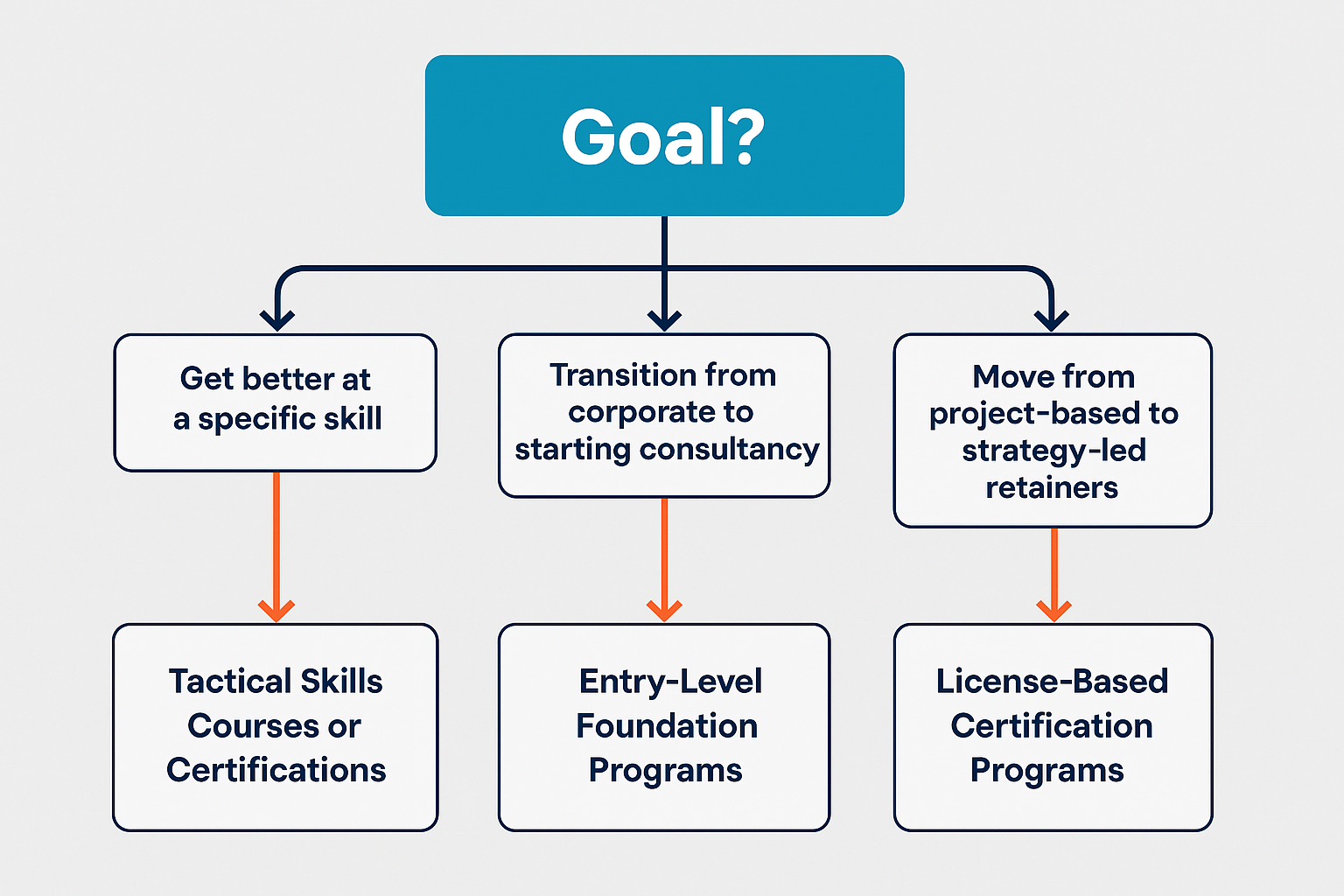
Goal: “I want to get better at a specific skill.”

Scenario: You’re doing consulting or running an agency and want to sharpen one skill – like SEO, Google Ads, or copywriting – without overhauling your business.

Program: Tactical Skills Courses or Certifications

What to Expect: On-demand video lessons or short workshops that teach one topic step by step. Limited support – maybe forums or weekly Q&A.

Investment: Usually free to a few hundred dollars. Time commitment is light (a few hours to a few weeks).

Pros: Affordable, focused, and flexible. Great for filling knowledge gaps fast.

Cons: Narrow scope. Little business guidance or long-term support.

Takeaway: For a single skills upgrade, skip the big programs. A targeted course or certification gets the job done quickly and cheaply.

Goal: “I want to transition from corporate to starting my own consultancy.”

Scenario: You’re leaving a corporate marketing role and want to start your own consultancy or solo agency. You have the marketing skills, but not the business-building know-how.

Program: Entry-Level Foundation Programs

What to Expect: These 4–12 week programs teach basics like packaging services, setting pricing, and finding clients. Includes video lessons, group coaching, templates, and community support.

Investment: ~$500–$3,000 depending on format and coaching.

Pros: Saves time and helps avoid early mistakes. Built-in support and templates fast-track setup.

Cons: Covers broad basics, not deep dives. Quality varies.

Takeaway: If you’re going out on your own, start with a program that teaches business fundamentals – not just marketing.

Goal: “I want to move from project-based work to strategy-led retainers.”

Scenario: You’re doing one-off projects and want to offer long-term strategic services instead.

Program: License-Based Certification Programs

What to Expect: Intensive training in a strategy framework, plus tools and templates for client delivery. Ongoing support through coaching calls and a private network.

Investment: ~$5,000–$15,000, plus possible licensing or renewal fees.

Pros: Provides a proven system and confidence to sell strategy retainers. Includes ongoing support and tools.

Cons: High upfront cost. Requires full commitment to the framework.

Takeaway: To move into strategy-first retainers, invest in a framework that gives you structure, tools, and support to reposition your services.

Related Articles: 

Goal: “I want to scale my agency past $1M in revenue.”

Scenario: You’ve built a stable agency and want help breaking through growth ceilings like hiring, positioning, or systems.

Program: Agency Masterminds or Accelerators

What to Expect: Includes coaching, mastermind calls, strategic playbooks, and live events. Emphasis is on scaling operations, team, and leadership – not tactics.

Investment: ~$10,000–$50,000/year. May require travel and 12-month commitment.

Pros: Offers mentorship and peer accountability. Helps fast-track decisions and avoid trial-and-error.

Cons: Requires time, money, and focus to implement. Fit depends on group quality and stage alignment.

Takeaway: For established agencies ready to scale, a mastermind or accelerator provides the strategic support and peer insight needed to grow faster and smarter.

Related Articles: 

  • Marketing Leadership as a Service (MLaaS)

Goal: “I want to become a fractional CMO with a few high-ticket clients.”

Scenario: You want to serve a small number of clients in a part-time, high-level strategic role – without managing a big team.

Program: Fractional CMO Coaching or Strategy Certification

What to Expect: Focus on packaging your offer, pricing retainer engagements, and leading strategy. Delivered via coaching, peer groups, or system-based certifications.

Investment: ~$5,000–$15,000 for certifications; ~$800–$1,000/month for coaching programs.

Pros: Helps position and sell premium strategic services. Often includes support, templates, and community.

Cons: Not easily scalable beyond your time. May require personal brand building and network leverage.

Takeaway: If your goal is fewer, higher-paying clients and deep strategic work, a focused program will help you build and sell a compelling fractional CMO offer.

Related Articles: 

VIDEO: Are You Ready to Be a Fractional CMO?

Making Your Decision: Which Marketing Training Program is right for you?

Choosing the right program comes down to matching your goal and stage with the program’s purpose:

  • If you have a single skills gap, take a course or get a specific certification (no need to over-invest).
  • If you’re just starting out on your own, build your business fundamentals with an entry-level program or community – getting those basics right will pay off for years.
  • If you need to level up your service offering, especially to incorporate strategy and get recurring revenue, a certification or licensing program that provides a proven system can be a game-changer.
  • If you’re already established and aiming higher, a mastermind/accelerator can provide the mentorship and peer group to break through growth plateaus.
  • And for those pursuing a fractional CMO model, ensure you have a strategic framework and support system in place – whether through a certification or a peer coaching group – to help you successfully navigate that niche.

Finally, remember that no program is a magic bullet. Your results will depend on your effort. The best program in the world won’t help if you don’t do the work, and even a mediocre program can yield value if you actively apply yourself and extract insights. Before plunking down money, get clear on what exactly you want to get out of it, and how you’ll hold yourself accountable to use what you learn.

Choose the Right Marketing Certification for Long-Term Growth

The landscape of marketing certifications and training programs for consultants, agency owners, and fractional CMOs is more diverse and more valuable than ever. Whether you’re looking to master a tactical skill, adopt a proven client delivery system, or join a high-level agency mastermind, there’s a training option designed to meet your goals.

As you evaluate your next step, start with clarity: What problem are you trying to solve? The best ROI doesn’t come from the most expensive program, it comes from choosing the right one based on your business stage, growth targets, and service model. From lightweight online marketing courses to full-scale strategy certifications, every program type serves a purpose

Lastly, be strategic with your education investments, just as you are with your business. When in doubt, lean towards programs that emphasize strategy, systems, and support/network – those elements tend to deliver enduring value. (That might be a tiny hint from our perspective, as we strongly believe in strategy-first growth and comprehensive support, given our own experience in this space.)

We hope this breakdown has helped clarify the options and trade-offs. By understanding what’s out there and assessing where you want to go, you’re well on your way to making a smart decision. Here’s to your growth – whether that means mastering a new skill, signing better clients, or hitting that next revenue milestone, the right program is out there waiting to help you make it happen. Good luck, and happy learning!

SEO Tactics That Actually Work in 2025

SEO Tactics That Actually Work in 2025 written by Jarret Redding read more at Duct Tape Marketing

The Duct Tape Marketing Podcast with Prasanna Dhungel

In this episode of the Duct Tape Marketing Podcast, I interviewed Prasanna Dhungel, co-founder and managing partner at Grow By Data. With decades of experience spanning marketing, tech, and SaaS, Prasanna brings sharp insights into the rapidly evolving landscape of search engine optimization—especially as AI transforms how users interact with search.

We explore the future of SEO in the age of Google AI, AI search results, and the zero-click search era. From adapting content strategy to optimizing for online visibility and brand performance, Prasanna breaks down how marketers can stay relevant, rank better, and actually get results in 2025 and beyond.

If you’re still using SEO playbooks from 2015, it’s time for an upgrade. Between AI-powered search results, changing user behaviors, and increased competition for attention, modern SEO demands a smarter, intent-driven, and more brand-conscious approach.

Key Takeaways:

  • SEO Isn’t Dead—It’s Evolved
    With AI overviews and new SERP formats, traditional SEO has shifted. Businesses must rethink both organic search and paid search strategy to remain visible.

  • Zero Clicks Can Still Drive Value
    Even without direct traffic, appearing in AI SEO and Google AI overview results can reinforce brand visibility and improve long-term recognition.

  • Content Needs Purpose
    Brands should focus on content marketing that drives interaction—like quizzes and infographics—especially when top-of-funnel reach isn’t converting.

  • Focus on Keyword Intent
    Prioritize high-intent search terms over broad awareness content. Think about what your audience is trying to solve, not just what they’re curious about.

  • Track Share of Voice
    Traditional rankings aren’t enough. Monitor share of voice across search features like shopping, Reddit snippets, and AI panels to measure content performance more accurately.

  • Reddit Is the New Authority
    Understand where your industry is being discussed and how your brand is represented. Participating in authentic conversations can influence both perception and rankings.

  • Optimize for AI Discovery
    Use structured content like bullet points, product attributes, and schema to increase your chances of being picked up by Google AI and LLMs.

Chapters:

  • [00:09] Introducing Prasanna Dhungel
  • [00:53] How to Prepare for Changes in Search?
  • [05:06] Is Intent Driven Content the Way Forward?
  • [07:16] What Metrics Should We Be Tracking?
  • [10:39] Best Practices to Show Up in AIO
  • [16:20] Measuring ROI Without Attribution

More About Prasanna Dhungel: 

  • Check out Prasanna Dhungel’s Website
  • Connect with Prasanna Dhungel on LinkedIn

John Jantsch (00:00.676)

Hello and welcome to another episode of the Duck Tape Marketing Podcast. This is John Jantsch and my guest today is Prasanna Dungal. He is nearly two decades of experience building businesses in marketing, tech, healthcare, and SaaS. He’s a managing partner by Grow at Grow by Data. He holds a bachelor’s degree with honors from Cornell, a master’s in engineering from Princeton, and an MBA from Kellogg School of Management. means he paid a lot to get educated. He was born.

and raised in Kathmandu. Probably the first Kathmandu on the show today, but he now resides in Boston. So welcome to the show, Prasanna.

Prasanna Dhungel (00:40.91)

Thank you so much, John, for the nice introduction and I look forward to the conversation.

John Jantsch (00:45.392)

Yes, yes. So we’re going to talk basically about SEO today. And I know that’s a lot of the work that you do at Grow by Data. A lot of change, know, AI, other things going on, a lot of, I mean, you even see people on LinkedIn saying SEO is dead. So how are you telling people they need to prepare today for changes in traditional search results?

Prasanna Dhungel (01:12.622)

Yeah, that’s a very hot, popular topic for folks in source, growth marketing, marketing altogether. You’re right. I don’t think SEO is dead. I think it has evolved. In fact, it’s the era of Google AI and just chats and all of these, in fact, has provided further impetus, in my mind, to storage.

Because the way I like to think about search is you’re asking a question and Google is answering today, but then new sources are answering. And you’re trying to understand how the answers are being presented, whether it be visually. Like in retail, for example, we like to say that the search result page is increasingly becoming like the Amazon results page, with a lot of product pictures being visible, your Reddit being visible, many times like, you

John Jantsch (02:06.372)

Yeah.

Prasanna Dhungel (02:12.236)

over the last year or so, videos and so on. So I think search has evolved. You have to look at paid search and traditional SEO in a new lens. And in fact, it’s created, I mean, there’s just a lot of interest to capture that. And I think the ones that are really going to win are going to be ahead versus be stuck in his or her old ways. But I think there’s a opportunity ahead.

John Jantsch (02:41.486)

Well, the one thing that I think is leading a lot of people to saying, I mean, people are seeing their organic traffic dropping. mean, I think that’s reality, but then they’re also go to the Google homepage or search page and they see the AI results or AI overview that comes there. And you know, there are many people that they get their answer and off they go. Right. So the so-called zero click, you know, era I think has really got a lot of people worried that, you know, all the effort they spent on producing content.

over the years is now going to go away.

Prasanna Dhungel (03:14.444)

That’s a fair concern. And the concern is Google is answering the question right on the sort page versus now letting us click and go into the page. So that remains. The way that we will have to see how that evolves, the next few months or the next year. Some are, in fact, saying it’s because of that that

John Jantsch (03:23.544)

Right. Right.

Prasanna Dhungel (03:42.264)

Folks like us are moving to newer channels to discover, right? But that said, folks are also using it as an opportunity for brand building, which is when you get picked up by these zero click results, you are in fact reminded, like you’re seeing a TV ad almost, and you’re remembering a brand, and then ultimately you remember that to make a purchase. So…

That’s one way that I know brands are thinking about it. But that said, I think just relying on that is challenging. Perhaps top of awareness studies keywords have had fewer clicks, or if any. And then increasingly, know source marketers are focusing on other types of content which require someone to click and go in. But the other way I like to actually show the positive is

If you are visible on Google’s zero source clicks, it could also indicate that you could be more friendlier to LLMs. And so you could get picked up by some of the chat engines. And so if you’re not getting picked up at all, I think that’s a problem. You want to get picked up. can obviously, you can rely on it alone. You have to use other sources, but you had to get picked up so that you also get picked up in the other sources.

John Jantsch (04:54.02)

Mm-hmm.

Prasanna Dhungel (05:09.228)

which in fact are almost like zero clicks or just even on the chat. That’s how I think about it.

John Jantsch (05:16.494)

So people are, mean, content is, you mentioned content and I want to go to types of content. One of the bits of advice I’m hearing from a lot of folks is this idea of a lot of information content, the how-to type of stuff is really what Google is kind of consuming in the AI overviews. But if somebody is actually searching to solve something or searching for a specific type of…

company, you know, those high intent searches are still there and happening. Would that suggest that we should be moving our content very much to much more intent driven content as opposed to kind of that top of the funnel, you know, show up in search content?

Prasanna Dhungel (06:04.334)

So I think it depends, right? If you believe that the top of the funnel content serves what we are trying to find very well, right? Then it may not be worth being the ninth or the tenth brand out there to capture that. There’s diminishing return, right? However, if you feel like your point of view is very strong, then why not create the brand in the first place? It’s about brand touch point.

John Jantsch (06:15.172)

Mm-hmm.

John Jantsch (06:33.166)

Mm-hmm.

Prasanna Dhungel (06:33.806)

But assuming that’s not the case, you are right. I do think then, you know, trying to go in and capture demand, you know, in the middle of the funnel or lower funnel, you know, and then really trying to draw someone searching from those is also a wise strategy that I know many have followed. Like we were talking to a large financial services client recently, and what they were telling me is, hey, you know, we’ve, we, I mean, we don’t see the ROI of really investing in top of the funnel content anymore.

John Jantsch (06:59.928)

Mm-hmm.

Prasanna Dhungel (07:03.148)

because we’re not getting folks to come to our site. And many times I talk about the brand being mentioned on top of the funnel, but sometimes the brand isn’t even mentioned. And so it even defeats the purpose of presenting your brand in front of someone. And so these guys were, in fact, creating newer types of content like quizzes or infographics or more deeper content that needs the user to interact to get the answer. And that’s where they were gravitating towards. And I’m actually seeing more and more brands do that.

John Jantsch (07:33.028)

Well, are there metrics, new metrics, different metrics that we should be tracking today to really understand how, although this AIO is kind of affecting our search.

Prasanna Dhungel (07:46.232)

We like to use share of voice as a metric to really track a brand’s visibility on Google, on Google AIO, on Batesource, what have you. And then we like to dissect it by different lines of business, by different intent, by different geographies, by different languages. So that’s the 50,000 foot metric that we use. But that said,

I do agree with you. think a question that you want to begin to answer is, OK, if AI results are a proxy to brand visibility, then how much brand searches are you getting? And is that rising midterm? Is a metric I think you should be tracking?

Like if you’re doing the right things, even if you’re not getting the click, are people remembering your brand? And not just the brand term, but brand plus. And then there may be a time lag. For example, you know, when I purchase something, it might be a few weeks out, it might be a few months out. Or am I seeing, you know, so one way to do this would be, you know, am I visible in these results, zero click results? And is that rising? And then after a few weeks out or so,

Is the amount of brand searches rising and is that compounding? I I think that’s one way I’ve known that brands are tracking that.

John Jantsch (09:19.856)

So break down share a voice just at, I’m sure that every client’s different, but you know, essentially how do you start measuring share a voice?

Prasanna Dhungel (09:26.958)

Sure, so I like to give the example of running shoes, right? So imagine I am searching for running shoes, running shoes, men’s, women’s, and so on. So when you search for that keyword or a group of keywords, you want to be searching not just once, but over time, across different geographies, across different devices, across different times of the day, so you have enough sample.

And what you have to do is, how often is your brand mentioned on the search page? So for example, on shopping ads, how often is Nike visible versus Adidas or Hoka? On your classic blue links, how often is Nike visible? On virtual listings, which is a free product listing from Google, how often is it? So if you imagine real estate on the page and there’s 1,000 spots in there,

and the spots are consumed by videos, shopping, and organic, and even Reddit and so on. How often is Nike’s domain visible? Or Nike mentioned, you just kind of say it’s visible maybe 300 times over your sample size. Then we like to say you have a 30 % share of voice. And you might care to understand how that varies by Spanish versus English.

New York versus Toronto and so on. So you slice it but at the highest level it’s how often are you visible in that real state.

John Jantsch (11:01.934)

So in this AI overview world, the zero click world, are there things that you are helping brands try to understand? Like, obviously we want to show up there, but is there an intentional approach or are there best practices to make sure that your brand is showing up there? Or is it simply a matter of if you’re showing up high in search anyway, for some of those terms, you’re probably going to show up in the results? Or is there a way to get your content intentionally to show up in

the AI overviews.

Prasanna Dhungel (11:32.856)

Sure. So what we do is we dissect what are the sorb elements visible within AIO, right? So you have, like in retail, you have maps sometimes show up on the AIO results. Sometimes you have a description. Sometimes you have the product that shows up, you know, like you’re trying to discover products. So the first thing to do is really try to understand, deconstruct AIO, what exactly is visible by different types of source terms. You know, so sometimes if you are

John Jantsch (11:39.236)

Mm-hmm.

Prasanna Dhungel (12:02.254)

trying to, if you source for a bottom of the funnel type of a question, if AIO does show up, it’s a different mix versus on the top. So that’s one. The second is we look at whose brand is being mentioned on each of these sort elements. Like for example, who is getting the free listings on running shoes? Which brand is it? And then we try to deconstruct, OK, the why.

And what we’ve seen is there’s a few elements to getting picked up on AIO. Sometimes the way the content is written, you know, in bullet forms versus free flow text, we’ve seen that that gets picked up. Many times for retail, we’ve seen that inclusion of attributes like GTIN, you know, and rich product attributes on the PDB page also helps you get picked up. Sometimes other attributes like reviews and ratings and pricing.

John Jantsch (12:51.556)

you

Prasanna Dhungel (13:00.61)

These other product dimensions, if it’s rich, then it gets picked up. So at a high level, think for your traditional text, having bullet forms and making it easier, understandable, having questions in there, not long content, that has gotten picked up, number one. For retail, it’s really rich product attributes on the PDP page. And making sure that if you’re not getting rejected by Google Merchant Center,

or if you’re not getting flagged by Google Merchant Center, then it’s likely to get linked. And then the classic techniques of being cited by credible sources, those are other signals we’ve seen.

John Jantsch (13:44.11)

So we’ve been talking a lot about the AI overviews, but if you scroll down pretty much any search these days, scroll down a little bit, some of the top organic results are being delivered from Reddit. And so, you know, know a lot of people are starting to pay attention to that and go, well, how do I get my stuff to rank on Reddit? What are you telling clients about their participation in Reddit? It is much different than say Facebook and LinkedIn in terms of the ecosystem there and the culture there.

so how are you advising folks to, to hopefully get some of their content or their, their answers, whatever it might be to show in Reddit.

Prasanna Dhungel (14:23.438)

Sure. we were, I’ll give you a live example. We were working with a large shoe company and the first question they were asking us is, is Reddit visible on the sorp for the questions that I, for the queries that I care to. And so we helped them understand how, what questions Reddit was visible on. And number two, we went into Reddit and then what we helped them understand is how they are portrayed.

John Jantsch (14:38.244)

Right.

Prasanna Dhungel (14:52.75)

you know, to folks like us, like, you know, if you’re trying to source for running shoes, who is very active, like who is active on Reddit? Is it Nike? Is it, you Hoka? Is it Adidas? And then how large of a community that Reddit thread has for say Nike running shoes or Nike running shoes. And so what we tell clients is first of all, try to understand where Reddit is visible. Number two, really try to understand your

your Reddit thread versus your competitors Reddit thread and is it one that you have a community manager running or is it just organic? And then the other thing we do is we’ve actually helped clients answer a bunch of questions on Reddit. One is we find that a lot of people are talking about pricing on Reddit. What does that sentiment look like? What does product quality look like?

John Jantsch (15:45.572)

Mm-hmm.

Prasanna Dhungel (15:51.778)

you know, and then how people are saying good or bad things about it. And so by giving that visibility, what we recommend, what we recommended to this client is you, I mean, they didn’t have a community manager and we said, you know, it’s an increasing channel. know, you get a lot of visibility. People are going there to understand what they like about your product. They’re giving ideas. And so we were recommending that they have a community manager who constantly analyzes and stays on top of it.

and then curates the experience. So you cannot just say whatever, but that said, remaining passive is also not a good idea. You want to have a point of view and sometimes there might be an opportunity to run an ad. When someone has a concern about the brand, then advertisement is a source of being on top of those that are looking at your brand. So you also have a strong point.

So these are some of the techniques that we have been telling clients.

John Jantsch (16:51.982)

So what kind of pushback are you getting on? And this is always the case, but we went through a period there where everybody was leaning on attribution. Like if you can’t prove that this got me a customer, then I don’t want to pay for it. And now we’re telling people you’ve got to be here and here and here. some of these places, a community manager, for example, is not a salesperson, right? They’re not going to create conversions. So how are you helping people kind of

Prasanna Dhungel (17:15.032)

Yes.

John Jantsch (17:21.276)

work through that ROI conversation when in some ways we’re talking about participating and engaging in ways that you can’t measure.

Prasanna Dhungel (17:31.34)

Right, so your question is, how are we helping clients think through the question of, if I put a dollar and the returns aren’t obvious, like a community manager, how should they think about it? And so the way we like to describe this is, if you use search as a proxy, then there is a certain amount of, the search volume is a proxy on demand for your service or product.

John Jantsch (17:41.08)

Yes, exactly. Exactly. Yeah, yeah.

Prasanna Dhungel (18:00.788)

And so, know, if what you’re being exposed to is a lot of Reddit in there, right. And then a certain percentage of them click through, you know, your classic CTR model there and they go in and it’s a highly uncurated, poor experience. Then you’re losing, right? So it sometimes is defense and sometimes it’s offense. So offense could be, you you put in a dollar and you get $3 back. Okay. But then.

defense is if you don’t have someone in there, it’s almost like insurance, right? If you don’t have a community manager, then your brand perception could be tarnished. And if you’re Rolex, as an example, and someone thrashes your band, and next year you want to raise prices, people are not going to pay $10,000. They actually already have an impression that Rolex is probably not $10,000, and you might want to get $1,000.

John Jantsch (18:32.196)

Yeah, yeah, yeah.

John Jantsch (18:39.832)

Yeah.

Prasanna Dhungel (18:58.774)

And the other part, in my mind, John, is think about the generation that is getting into Reddit. Some of the brands we work with, they have a slightly more older demographic. And they’re trying to recruit younger demographics to, in fact, purchase from them. And the younger demographic are going into these communities. And the first impression they have, if there is no impression or if the impression is bad, then you are

John Jantsch (19:11.533)

Mm-hmm.

John Jantsch (19:20.483)

Yeah.

Prasanna Dhungel (19:28.294)

not going to get them on board. So I like to even say that brands have begun to think of this investment almost as defensive. It’s like a leaky funnel, right? If you don’t yet go to Home Depot and buy something to fix your faucet, then you’ll just keep leaking. That’s also a way that brands have in fact approached that question.

John Jantsch (19:30.232)

Yeah.

John Jantsch (19:39.736)

Yeah, yeah, yeah, yeah.

John Jantsch (19:49.412)

Yeah, yeah, yeah, yeah, makes sense.

John Jantsch (19:54.584)

Yeah. Well, awesome. Well, lots of changes, lots going on. I appreciate you stopping by the Duck Tape Marketing Podcast. Is there somewhere you’d invite people to connect with you and learn more about the work that you’re doing there?

Prasanna Dhungel (20:05.462)

Yeah, absolutely. So you can connect with me on LinkedIn, Prasanna Dhungyal. Or you can go to our website, growbydata.com, and you’ll find me on the executive team. You can find me on LinkedIn, on Twitter, PD277. Happy to be helpful. And this is a fast-changing work area and would love to be helpful and supportive.

John Jantsch (20:30.116)

Well, again, I appreciate you stopping by and hopefully we’ll run into one of these days out there on the road.

Prasanna Dhungel (20:34.656)

Absolutely. Thank you so much,

Weekend Favs April 5th

Weekend Favs April 5th written by John Jantsch read more at Duct Tape Marketing

My weekend blog post routine includes posting links to a handful of tools or great content I ran across during the week.

I don’t go into depth about the finds, but I encourage you to check them out if they sound interesting. The photo in the post is a favorite for the week from an online source or one I took on the road.

  • Mint.ai is an AI-driven advertising platform that integrates AI agents, data, and workflow automation to optimize processes in marketing and media.

  • Adzooma is an AI-powered platform that simplifies online advertising by managing and optimizing ads across multiple channels, including Google, Facebook, and Microsoft.

  • Trapica utilizes AI to automate and optimize ad campaigns, targeting the most relevant audiences and adjusting strategies in real-time to improve performance.

These are my weekend favs; I would love to hear about some of yours – Connect with me on Linkedin!

If you want to check out more Weekend Favs you can find them here.

The Future of Marketing Is More Human Than Ever

The Future of Marketing Is More Human Than Ever written by Jarret Redding read more at Duct Tape Marketing

The Duct Tape Marketing Podcast with Carlos Gil

In this episode of the Duct Tape Marketing Podcast, I interviewed Carlos Gil, global marketing leader, bestselling author of The End of Marketing, and Brand Evangelist at GetResponse. Carlos is known for his bold approach to digital marketing, particularly in how brands can rise above the noise in a world dominated by AI, social media, and content creation.

Carlos challenges the status quo with his core thesis: Marketing as we know it is dead. The future isn’t just about technology—it’s about reconnecting with people. As AI tools like ChatGPT reshape the landscape of content marketing and digital advertising, brands must refocus on what can’t be automated: human relationships. From employee advocacy to authentic storytelling, Carlos shares actionable strategies for creating a brand strategy that thrives in a tech-driven world while staying rooted in human connection.

Carlos Gil’s perspective is a timely reminder: in the race toward automation, don’t lose the human heart of your brand. The brands that will win in the future are the ones that embrace empathy, connection, and authentic communication—at scale.

Key Takeaways:

  • Marketing is evolving—not ending. Brands must adapt by becoming more authentic, relational, and human-centric.
  • AI in marketing is powerful, but limited. Tools like ChatGPT can support email marketing and content creation, but they can’t replace real brand relationships.
  • Employee advocacy beats influencer marketing. Instead of outsourcing trust, Carlos encourages companies to empower employees to become true brand evangelists.
  • Omni-channel marketing is essential. Businesses must diversify their presence across platforms while prioritizing ownership of their audience through email and direct communication.
  • The most effective marketing strategy? Human connection. Creating real value through stories, vulnerability, and engagement helps brands rise above algorithm-driven sameness.

Chapters:

  • [00:09] Introducing Carlos Gil
  • [02:23] Brands Need to Humanize
  • [07:46] AI and the Need for Human Relationships
  • [12:25] Communicating the Human Element of Your Brand
  • [15:49] Omni-channel Marketing

More About Carlos Gil: 


John Jantsch (00:01.09)

Hello and welcome to another episode of the Duct Tape Marketing Podcast. This is John Jantsch and my guest today is Carlos Gill. He’s a global marketing leader and author. He’s a US brand evangelist at GetResponse with over a decade of experience helping brands thrive in the digital age. He’s also known for his bold results-driven strategies and insights on leveraging AI, social media, and email marketing to drive growth and engagement. Today we’re going to talk about his latest book,

The end of marketing, humanizing your brand in the age of social media. So Carlos, welcome to the show.

Carlos Gil (00:36.991)

It’s great to be here on the show, John. Thanks for having me.

John Jantsch (00:39.232)

So wait, marketing is over, it’s not just evolving? Like it’s the end? What do mean by the end?

Carlos Gil (00:45.635)

the end is just that look, you know, the first line, then the marketing, it’s real provocative, the title itself is intended to be a provocative, engaging title to real people in and the first line of the book, not to spoil it for anyone, because I hope you go out and buy it, but it’s marketing as we know it is dead, right? And like, that’s the caveat that as we know it, and I say this, because I myself being millennial, right? I’ve been around now for multiple decades and generations, I’ve been able to see

John Jantsch (00:47.477)

You

John Jantsch (00:53.72)

Yeah, yeah.

John Jantsch (01:05.699)

Yeah, yeah, yeah.

Carlos Gil (01:14.079)

it’s kind of shift throughout my lifetime from once not having digital technology to having digital to having the web to now everywhere we turn, we’re seemingly connected and there’s this just friction between brands and consumers. And, I know we’re going to talk about the books. I don’t want to give too much away early on, but the whole premise of the end of marketing is that brands want to be able to rise above all the digital noise that’s existing today.

John Jantsch (01:15.918)

Mm-hmm.

Carlos Gil (01:42.377)

they need to become more human. And look, to be transparent with you, I wrote this book in 2019. It came out in 2019. The very end, this was before COVID. I then sat down and wrote the second edition during COVID in 2021, the second edition came out. And I have folks that reach out to me through social media, just about every single day, John. And they say like, wow, like, did you predict what was going to happen, especially with like the whole AI piece? Because I would say then the marketing speaks more so today.

John Jantsch (01:44.632)

Yes.

John Jantsch (01:48.302)

Hmm.

John Jantsch (02:05.752)

Yes.

Carlos Gil (02:10.335)

to a 2025 reader honestly than in 2019 when I wrote it.

John Jantsch (02:16.685)

You know, think though that that’s actually, mean, I’ve been around a little longer than you, uh, Carla said, so I’ve been doing this, uh, a little longer. And so I’ve seen these ups and bounds and I mean, people have kind of used this idea of the end of marketing numerous times because anytime something really changes, they’re like, Oh, the old way is dead. Um, so I, I, I, I 100 % agree. It’s changing faster than ever. This idea of, you know, all AI is creating.

more sameness and more noise than ever before. So touch a little bit more on this idea. I’ve been really preaching lately that I think branding or brands are going to become more important than ever. You use the word humanizing brands. How does a business need to be looking at that today?

Carlos Gil (03:06.803)

Look, when I wrote Dundee marketing, one of my inspirations behind the whole thesis, which is that if brands want to survive this AI apocalypse that we are like right now in, right? Whether you want to accept it not. Yes, it’s still the early days of AI, but what does that really mean? Like AI is evolving really fast. So early days of AI might mean that a year from now, like everything that you know about business is just completely flipped upside down on its head. So

John Jantsch (03:16.75)

Cheers.

Carlos Gil (03:35.453)

When I wrote this book, I started thinking about what’s the competitive advantage from a marketing standpoint for any business or any brand. And that’s relationships. And I know this having worked previously on the inside of brands, leading social media, having previously worked for LinkedIn, being a social network that you can’t really scale or automate relationships. Right? So when you think about what AI is able to do, yes, AI can

write copy for you a lot of the AI that we refer to as more so language models, such as chat GBT. So yes, AI can write website copy and social media copy and it can operate a lot faster than human being great. I love it. But at the end of the day, is it as effective as a human behind the controls? I think that’s that’s TBD. What I can tell you that AI cannot do is automate relationships between humans. That’s like a core theme of the

John Jantsch (04:32.162)

Mm-hmm.

Carlos Gil (04:33.427)

book. The core theme is just that like at the end of the day, whether you use technology to help you do your job or not, a relationship means means a lot, especially in this era that we’re in where I fully believe by 2030, the value of a relationship. I’m not talking about social media follower, I’m talking about real relationship being able to, you know, hop on a webcast, do something like this with you, connect people, sit down, have human to human interaction, there’s going to be an immense

John Jantsch (04:53.686)

Mm-hmm.

Carlos Gil (05:03.263)

premium on that experience. And for brands in order to stand out, you can’t automate that. So how do you stay competitive when you’re a multi billion dollar brand and you’re looking to stay competitive within your own category? Well, it’s simple, right? You’ve got influencers, right? That is one solution. But influencers, as I write in the marketing, they’re really just a band aid. They’re a temporary solution, right? You hire an influencer.

They promote your brand. see a little temporary bump in traffic to your website, right? It looks good. But when that influencer goes away, they take their following with them. So in order to sustain that success, you need to start making people the faces of your company. And ironically, the role that I’m doing now, what I’ve been doing with GetResponse for the last year, GetResponse being an email service provider that was created in the late 90s, is they brought me on board to serve in this brand evangelist role.

I really was that mean. So I wear multiple hats, right? Internally, I’m a marketing, you know, strategist, thought leader within the brand, but on the outside, I’m doing this, I’m on podcasts, I’m a company spokesperson, I’m speaking on behalf of the company at events. I just came back from South by Southwest, I was on the scene, creating video content. This what you’re kind of seeing in action through myself is honestly, John, like the perfect bow to put on my own book.

John Jantsch (06:01.004)

Mm-hmm.

Carlos Gil (06:30.163)

that I wrote the end of marketing because I’m living it, I’m doing it, I’m showing other organizations out there. This is how you humanize your brand through people. It’s not always hiring influencers, it’s having a really strong and effective employee advocacy strategy, it’s training your employees to really humanize your brand through their own content. And then it’s also going out and finding individuals that can embody your brand and bringing them within whether it’s hiring an influencer in house, right, to work for you for a year.

John Jantsch (06:46.52)

me

John Jantsch (06:58.541)

Mm-hmm.

Carlos Gil (06:59.475)

whether it’s hiring someone like myself to go out and create content on your behalf, it puts a human face and voice on the company. And I tell you what, this, I believe, is the new wave going forward for brand marketers and the smart ones that figure out that balance of how to still sell, how to still market, but doing it in a way that feels authentic. You’re doing it through a real human being. Those are the ones that are gonna stand out. Otherwise, I really believe you’re gonna start seeing a lot of companies

Start scaling back on social, start even scaling back their digital presence because, you’ve got AI that now is able to operate faster, move more lean, create content for you. And that in itself creates a real challenge for brand marketers.

John Jantsch (07:45.452)

You know, I’m seeing actually there’s, this whole kind of AI is going to replace people, you know, kind of a meme that that’s out there very wide. And, and there’s no question it’s replacing functions. but I actually had someone on the show the other day that has created it’s an AI tool. And they said that what it’s actually doing is they’re using AI to do a lot of, I don’t know, let’s call it grunt work, that, that people used to have to spend their time to do. And it’s actually freeing their people up to

to do more relationships and to spend more time, you know, just meeting with people, over lunch, you know, or whatever it, you know, it might be. And I think that that’s actually the way, the smart way that people are going to invest in their people is to not, to not look at this as like, we can, we can go down to two people now because we can have AI do all this. It’s like, no, we can actually re align or refocus what our people actually do that is going to, you know, establish this brand, you know, as a different, know, standout brand.

Carlos Gil (08:36.575)

100%.

Carlos Gil (08:43.263)

Yeah, look, 100 % I have a love hate relationship with AI. use AI throughout my day. But what I will say is that it’s very easy as a marketing professional to become reliant on AI to the point where it almost makes it hard for you to think for yourself. And that is free slope of all this technology, right? You become super reliant on it. And then chat GPT goes down. It’s like, oh my god, like, I forgot how to I forgot how to write. Right? Like,

John Jantsch (08:59.471)

It’s just

Carlos Gil (09:09.369)

It literally becomes like that. So what I always say is like, look, you need to find ways to make AI your trusted assistant. Historically, you have a marketing agency that you work with, you lean on them to write your social media ad copy, you lean on them to help you ideate like you have to build a relationship. You’re using chat GPT, right? You have to build a relationship with your chat GPT. There’s no other way around it. I have now spent a couple of years finessing and refining

John Jantsch (09:31.394)

Yeah, yeah. Yeah.

Carlos Gil (09:37.203)

But what I will say is the way that I use AI helps me actually be much more creative. Because I know now that I have a trusted companion within Chad GBT that if I’m, for example, in an airport and an idea comes to my mind, I can speak into my phone and I can get real time feedback. Right? I can help, you know, ideate with the help of AI without having to call someone, without having to pay an agency. Right? So like there’s that aspect of it that I believe has it’s good.

John Jantsch (09:46.232)

Mm-hmm.

John Jantsch (09:55.736)

Yeah. Yeah.

Carlos Gil (10:06.815)

But then there’s the other aspect of it that if you rely so much on AI to do all the heavy lifting, all the grunt work as you call it, or the menial tasks, now you are removing the human element out of things like copywriting or even writing an email or a text message. Like it’s crazy. I see people all the time now. I’m on airplanes a lot and they’re writing a text message and they go over to ChatGBT.

to almost like copy, edit the text and then they go back. It’s like, my goodness, like this is going to continue to create this friction as I like to call it between humans and technology. And it goes.

John Jantsch (10:37.038)

Yeah.

John Jantsch (10:45.566)

Imagine when we have an entire generation that that’s all they know.

Carlos Gil (10:49.821)

Well, like imagine what’s really scary is imagine you and I not even have to record a podcast because there’s so much content of you and there’s so much content in me over the years. The AI knows my face and my voice and it could just recreate this conversation. Like it exists right now. There’s AI conversational platforms that you can record 15 seconds of your voice and it will just record a podcast for you. It’s insane what it can do. And that’s great. We’re going to continue to see that.

John Jantsch (11:04.94)

Yeah, people are doing it. Yeah.

Carlos Gil (11:16.127)

I firmly believe that we’re entering an era where there’ll be bestselling books written by AI, top podcasts on Spotify that are created by AI. There’s gonna be new billionaires are created. There will be new billionaires created because of AI, because of systems. My whole point here though is don’t lose sight of human to human relationships. Like that will always outweigh

John Jantsch (11:22.822)

totally.

Carlos Gil (11:43.487)

what technology can do. And the reason for that is because, you know, this is like just old school business, right? It’s like, I’m going to speak right now that the Gen Zers out there, they’re listening or watching, like business has always been predicated based on who you like, trust and relate to. So if you like someone, you have a higher likelihood to do business with them. If you trust them, if you relate to them, you want to do business with people that you like, trust and relate to. And I’m sorry, in an AI driven world, where it’s really noisy,

John Jantsch (11:48.866)

Yes.

Carlos Gil (12:10.367)

Yes, it becomes challenging to sift through that noise. But inevitably, if you’re able to connect with people, IRL, or you’re able to connect with people online and kind of weed out the AI element of that relationship, like, yeah, man, it’s just old school business 101.

John Jantsch (12:28.238)

You know, a lot of times people, think everybody gets that, you know, that idea of be more human, be more human. But this sounds really silly, but I have a lot of people who are like, well, how do you do that? You know, how do you, how do you communicate that? And I, and I think the, the real thing that AI doesn’t do is it can’t make up a story that only I know, never will. Um, you know, right. So storytelling, uh, vulnerability, uh, I don’t see too much AI kind of saying, look, I made this mistake and here’s what I learned from it.

Carlos Gil (12:46.099)

Right?

John Jantsch (12:54.827)

So, I mean, think some of those elements need to be in our marketing to kind of show or communicate the humaneness, don’t they?

Carlos Gil (13:02.139)

Absolutely. And look, like the other element of this that I want to reel and it’s something I’m very passionate about right now is this whole notion of owning your data, right? Like AI aside, AI is great from operational standpoint, but we are living right now in this just noisy digital ecosystem. And I write about this in the book. I talk about this one when I’m on stage. I take it you’ve seen the movie Cast Away, John? Right. It’s one of my favorite movies of all time. And anyone that follows my work, whether you read it or you read my podcast,

John Jantsch (13:10.712)

Yeah.

John Jantsch (13:25.198)

yeah, sure, sure.

Carlos Gil (13:31.795)

like this, or you see me speak on stage, I always make analogies. I’m like, what kind of has helped me as a marketer define my voice in this whole space is I’m not a textbook marketer. one these guys that I’ve been in the trenches, I’ve done the work, I’ve worked in corporate, I’ve started businesses, and I learned and I go out and teach. And I use a lot of analogies. So my point of where I’m going with this is that in the movie Castaway, Tom Hanks is stranded on this island. And throughout the movie, he’s talking to a volleyball named Wilson.

And I often use this comparison that we as digital marketers are the equivalent of Tom Hanks speaking to a volleyball, right? We produce all this content. We spend all this time in the lab making videos, making shorts, making reels, writing blogs. And if no one consumes them, right? No one’s listening. Then that is the equivalent of Tom Hanks speaking to Wilson. So you have all this noise that’s taking place every single day. And it’s not just brands competing against other brands. Like way back in the day, I used to run social media for a brand named Winn-Dixie.

there’s supermarket chain here in Florida. And the primary competitors was Publix and Walmart, and Albertsons and a couple other stores. Well, nowadays, if you’re a supermarket chain, just using this example, you’re not competing against supermarkets, so we’re talking about food, you’re competing against bloggers or vloggers, you’re competing against influencers, cooks, you’re competing against anyone that’s in your category, that’s taking market share away from your brand, which is why I go back to the basis of

relationships be important. And one of my passionate topics right now in this era that we’re in is this notion that you need to own your data. You cannot rely on these social networks to give you reach. You cannot rely on the little breadcrumbs that Metta or Instagram give you. You just can’t. We recently saw TikTok go through a very scary situation where they were temporarily banned. And that I believe should be a wake up call to every single business, every single creator, influencer, anyone.

John Jantsch (15:15.15)

you

Carlos Gil (15:25.545)

who’s relying on these technologies to grow and promote their business, you cannot rely on them. You need to use them for reach. You need to use them to create awareness for your business. But inevitably, you need to be taking those relationships, i.e. those followers, you to move them over into systems and platforms like email. You need to own data and you cannot be reliant because unfortunately, when you do become reliant on these systems, you are just putting too much control in their hands.

John Jantsch (15:53.71)

Yeah, you know, it used to be, mean, when, I don’t know, let’s say 2005, 2006 or so when social media started, you know, popping on the scene, it was very much seen as a top of the funnel. Like here’s how to get reach. Here’s how to get exposure. Here’s how to get seen. But you got to drive people back, you know, to the property of your own. Mainly, we tried to drive people back to our websites, right? We’d post our blog and say, here, come read my blog here. Well, now a lot of those platforms.

Don’t ever want you to leave. And so, you you get penalized for doing any of that kind of drive people back. And another thing I’m seeing happen is, you know, on TikTok, you’re seeing entire journey or entire, you know, funnel happening on TikTok. It’s no longer just top of the funnel. People are actually transacting. So, so how, how do people kind of balance that idea that I now need to be more places with like a full, you know, full range of content as well as, you know,

I 100 % agree, own your own data.

Carlos Gil (16:56.157)

You know, I’ve been saying this, John, since probably about 2015 when I started speaking. I go back and I look at some of my earlier content. I’m like, man, I’ve been saying the same thing for a decade now. And one of the key terms I have said to folks, and this goes back to when I worked in corporate marketing running socials, have an omnichannel presence. Don’t be married to one platform. Use these platforms the way that they use you.

And I’ll just tell you as someone that has spent a lot of time in these platforms as a user, and again, having worked for a major social network, these social networks at the end of the day, they all do the same thing. They’re all digital advertising platforms. And I think this is something that’s lost upon the majority of creators because again, like let’s think of it, your average business owner, your average influencers using platforms, they’re just trying to get rich. They’re trying to continue to build a community, get followers. The name of the game should not be to get followers.

Your objective as a business needs to be to generate more revenue, right? Followers, it’s a vanity metric, right? Like, you know that you’ve worked in the industry for a very long time as well. So I always am constantly preaching this. Use these platforms the same way they use you. The way they use you is they’re using you because you’re creating contents, keeping people on the platforms. And as long as you’re keeping people on the platforms, they’re selling more ads and they’re making more money, right? Like they are in the business of making money. That’s what these social networks do. And again,

John Jantsch (17:52.878)

Yes.

John Jantsch (18:20.184)

Yeah. Well, and let’s throw Google in under the bus too. mean, that’s what Google’s, you know, existence is as well.

Carlos Gil (18:25.193)

Yeah, it doesn’t make them bad. Like by any means, like if anyone from Google or LinkedIn or better, any of these platforms are listening or watching, like this doesn’t make them bad. It’s just understanding the game. Like these are businesses. So if I am running a business, right, I always use this analogy again, going back to the analogy, if I, for example, am running, let’s just say a flea market, right? We all know what a flea market is. You cannot walk into my flea market and set up a table and sell without paying a hundred bucks to the owner of the flea market.

John Jantsch (18:35.554)

Right. Yep.

John Jantsch (18:49.762)

Right.

Yeah, right,

Carlos Gil (18:53.929)

to rent for a day. If you’re a barber, you can’t go to a barber shop and cut hair and not expect to give the owner his or her cut. That’s just business. Social media networks operate the same exact way. And again, it doesn’t make them bad. You just have to understand the rules of the game. And normally when I do my talks, have like, sorry, I have this slide behind me and it has like a casino and like Zuckerberg’s face in front of it. And I always say like,

look at meta, for example, and like they are a form of casino, because they’ll give you a little dopamine, they’ll let you win here and there in the form of a viral video or your post might reach, you know, more than 1 % of your following audience. But they’re not gonna let you win all the time. And they’re not gonna let you do it for free. And you have to pay to play inevitably. And again, man, like I love this space. Like, I know we’ve talked about AI, and we’re trying to get as much in and in the time that we’re together. I love I just love the space, man.

John Jantsch (19:24.654)

Yeah.

Carlos Gil (19:50.911)

I’ve worked in social media professionally since oh wait, I got onto social media in 1995, back then when I was 12 and it was known as AOL. I have grown up evolving with this in my life. I’ve made a lot of money as an entrepreneur using it. I’ve made a lot of money as a creator using it. I’ve helped businesses make a lot of money using these tools. Like I love them. They’re great. However,

where I do keep it 100 as a thought leader and speaker in the space is what I’ve already said. And I’ll repeat it one more time. If it’s cool, you cannot rely on these networks alone. You have to have an omni-channel strategy. And that means go wide, have a presence on multiple platforms, build a community within those platforms. Don’t just rinse and repeat your content because now you’re not giving people an incentive to go follow you in different channels. And most importantly, you need to find ways to own your data, which is pretty simple. Start up a newsletter, right?

John Jantsch (20:33.038)

you

Carlos Gil (20:45.671)

to get response, sign up, get a newsletter. And then as you’re creating content that people enjoy seeing, remind them, hey, if you want to see more of this, if you want to be a part of my insider circle, my club, my mastermind, however you frame it, now you have a solution to give people that you own. So you don’t have to rely on the out.

John Jantsch (21:02.435)

Yes.

Yeah. I, know, just another practical nod to that idea is that a lot of times people have to bump into you in about five places before they start paying attention. you know, so it’s, it’s the old, gotta hear, you know, I gotta hear your message or see your sign or whatever it is multiple times before I’m really going to, to start tuning in. Well, Carlos, I appreciate you taking a moment to stop by the duct tape marketing podcast. Where would you invite people to find, to connect with you first off, but then find out more about the end of marketing.

Carlos Gil (21:34.303)

Yeah, for sure. So once again, John, thank you so much for having me on your podcast today. It has been a pleasure. You can learn about the end of marketing by going to Amazon. Just look up end of marketing. There’s the first and second edition. Also, I want to call out, get response, shout out, get response, go to get response.com. You can sign up for a free trial there. If you have any questions with regards to setting up a newsletter, email marketing, please be sure to reach out to me. You can connect with me on all the socials, Carlos skill 83 and LinkedIn.

is my go to platform of choice if you want you can connect on me there but I love Instagram I love tiktok love Facebook I am a proponent of look let’s get to know each other LinkedIn is great but you only get to know so much about me and me of you on LinkedIn it’s professional social network and at the end of the day so if you’re on Instagram look me up at Carlos guilty 3 let me know that you heard this episode of the duct tape podcast and any way that can help you out let me know I’m here I got you

John Jantsch (22:32.878)

Awesome. I appreciate it, Carlos, and hopefully we’ll run into you one of these days out there on the road.

Carlos Gil (22:37.599)

All right, John, I appreciate you.

Your Book Launch Needs a Marketing Plan

Your Book Launch Needs a Marketing Plan written by Jarret Redding read more at Duct Tape Marketing

The Duct Tape Marketing Podcast with Alex Strathdee

In this episode of the Duct Tape Marketing Podcast, I interviewed Alex Strathdee, CEO of Shelf Life and author of Before the Bestseller. Alex is an expert in book marketing, having helped over 1,000 authors across 50+ niches get real results. His insights challenge the traditional belief that publishers will promote your book and reveal the essential strategies every author must use to drive their own success.

During our conversation, Alex shared powerful and practical advice on how to sell books, create a compelling book launch plan, and avoid the most common book marketing mistakes. From free reader seeding to building an author email list, Alex outlines a repeatable book sales strategy that empowers authors to treat their book like a business asset—whether you’re self publishing or working with a traditional publisher.

Alex’s approach to nonfiction book marketing is data-driven, entrepreneurial, and deeply practical. Whether you’re a seasoned business owner or just starting out, the insights from this episode can help you avoid wasted effort—and get real ROI from your book.

Key Takeaways:

  • Publishers won’t market your book. Authors must take ownership of their book promotion strategy.
  • Think of your book like a product. If it’s good (and light, as Alex says), it needs only wind—your marketing—to take off.
  • Pick a sales goal. Whether it’s 1,000 or 20,000 copies, defining a target helps guide every marketing tactic.
  • Use free reader seeding. Get your book into the hands of people who can talk about it and create buzz.
  • Break down your sales goal into channels. Consider email, podcasts, Amazon ads, or lumpy mail to move copies strategically.
  • Your email list is gold. Start small with 100 engaged readers and build from there—this is traffic you own.
  • Use VA support for outreach. Outsourcing book promotion tasks helps you scale more efficiently.
  • Don’t overlook physical presence. Alex shares how one book sold millions after being spotted in a car wash!
  • Design a book funnel. Use your book as a lead magnet for higher-ticket services like courses or coaching.
  • Presentation matters. From soft t-shirts to custom editions, packaging your book with care can spark word-of-mouth and long-term publishing success.

Chapters:

  • [00:09] Introduction to Alex Strathdee
  • [01:03] Do Publishers Promote Books?
  • [02:45] Mistakes in Book Marketing
  • [06:54] How is AI Affecting Book Marketing?
  • [08:30] What is the Goal of your Book?
  • [09:39] Seeding Readers with no Audience
  • [13:34] Team and Tools to Help You with Your Book
  • [16:03] Positioning Yourself to get Lucky

More About Alex Strathdee: 


John Jantsch (00:00.951)

Hello and welcome to another episode of the Duct Tape Marketing Podcast. This is John Jantsch. My guest today is Alex Strathdee. He is the CEO of Shelf Life, where he helps authors market books. After working with over 1,000 books and 50 plus niches, he wanted to know what advice to give authors whose books weren’t selling. Clients include Mike McCallewitz, Alan Dibbs, Michael Bungastanier, Tony Fidel, Reid Hoffman. He hosts.

his own podcast, Before the Best Seller with authors who have sold over 10,000 copies, which include Dan Pink, Kim Scott, and others. But we’re going talk about his book today, Before the Best Seller, your proven path to book sales without wasting time and money. So Alex, welcome to the show.

Alex Strathdee (00:47.864)

John, it’s a dream come true being here growing up with you as one of the marketing greats to get to have a chat with you is pretty cool.

John Jantsch (00:55.227)

I appreciate that. So I know the answer to this, but I’m just going to let you let you hit it out of the park. When I write a book, doesn’t the publisher promote my book?

Alex Strathdee (01:09.422)

You would think that is why we exist is because Seth Godin, I know, has a good statistic that, you know, authors spend 90 % on or they make revenue from 90 % of the 90 % of the revenue is from their backlist and they only spend 2 % of their their budget on actually launching new books, which is a statistic that every author should be listening to and thinking, oh, so I can’t expect my publisher to actually market.

John Jantsch (01:10.627)

Yeah.

John Jantsch (01:24.835)

Huh.

John Jantsch (01:36.725)

Yeah, I’ve actually published, let’s say I self-published one book, six books have been with major publishers. And I can say that not only do they not promote your book, they don’t know how, quite frankly. I mean, they’re pretty rooted in some ancient approaches.

Alex Strathdee (01:56.43)

And that’s how I came into this industry was actually getting like pretty much scammed by someone who was like, oh, here’s what book marketing really is. And I was like, oh, wait, I’m going to be our famous rich, you know, author tomorrow. Wow, that’s fantastic. All I have to do is become an Amazon bestseller. Cool. And then you quickly find out that’s that’s not how you become an author.

John Jantsch (02:11.458)

Yeah

John Jantsch (02:16.035)

Well, and the other thing of course, and I’m sure you’re experiencing this, my first book came out in 2007. There weren’t a lot of nonfiction books, quite frankly, particularly from marketers. Now there’s probably been five titles that have come out since we started this show. I mean, it’s crazy.

Alex Strathdee (02:32.942)

There’s a marketing book for every niche now. There was one book that I was marketing that is, Kroll Space Repair. It’s insane, the niches that you find these days. But I love niches. I think niches are some of the best places to market.

John Jantsch (02:47.285)

So where do you find, we’ll start with the mistakes. Where do you find people making a mistake? I know the biggest one is they write a book and go, okay, now what? Probably, but what are some of the other common mistakes?

Alex Strathdee (02:56.77)

Yeah, the first. I’ll first start with a piece of education and it’s how to think about your book, and it’s a analogy that I actually stole from Ricardo Fayette of Reidsy, and it’s it’s the book is a ship analogy where essentially your book is a ship and how good your book is is how and how, you know, the word of mouth will spread for that book is how light the material of that ship is made of. So if you have a really, really good book, you have a really young.

think I was reading your Wikipedia before this as well. You like your woodworking, so we’ll use a nice wood reference here. You know, if you have a really good book, then it’s a light piece of wood, right? So, you know, then your book, all that that ship needs is some wind in the sails and it starts to cruise along. If your book is made of lead, meaning it’s a terrible book and people don’t want to share it, then yeah, you can strap rockets to the side. But the second you turn off those rockets, it’s going to sink to the bottom of ocean. So the first thing is to think about your book as a ship.

John Jantsch (03:46.563)

You

Alex Strathdee (03:54.72)

And so the next question you get is, well, how do I know what my book is made of? And the answer to that is by product testing it. So it’s by committing to. this is, your question was, where do people actually start with their marketing? The starting point is picking a number. So that is the Bill Gladstone, who’s the late former literary agent to people like Eckhart Tolle, Marie Kondo, Jack Canfield. His whole thing is that in order for a book to be commercially successful, you need to see 20,000 copies into the wild.

Now, if your book is about crawl space repair, the odds of you seeding 20,000 copies is pretty low, right? So you get to realize that there’s some nuance in here, depending on the industry that you’re a part of. Rob Fitzpatrick says that number only needs to be 1000. He’s a author of right. You saw books. He focuses more on like writing really, really good nonfiction books. And the truth is the numbers somewhere between 1000 and 20,000. And it’s up to the author to figure out what that number is.

John Jantsch (04:29.559)

Yeah, yeah.

John Jantsch (04:43.478)

It’s a book.

John Jantsch (04:51.053)

So.

I mean, again, I’m trying to process that comment. if I’ve published a book or self-published a book or I’m thinking about putting a book out, am I now then one of my first tasks is I need to get a thousand people who I think would be interested in this and send them a copy?

Alex Strathdee (04:58.094)

Yes. Yeah.

Alex Strathdee (05:12.46)

That is one of the ways. we call that free reader seating and the the but yeah, essentially once you have your number, what that is, is that’s empowering because where most authors start in their book marketing is just talking to, you know, like marketing salespeople of, you need this program, you need this program, you don’t really know what you’re trying to achieve. You just kind of think that like, well, if I make the New York Times bestseller list, then my book did what it’s supposed to do, right?

John Jantsch (05:13.709)

Yeah.

Alex Strathdee (05:36.814)

And so just having an understanding of what you’re actually trying to achieve with your book is that will solve half of your marketing issues. Because once you have your number, you break that down into, OK, I’m going to move 200 copies through podcasting. I’m to 100 copies through my email list. I’m going to move 200 copies through Amazon ads. Right. And then you actually break that seeding number down into many goals. And those are the different tools of book marketing that I talk about with him.

John Jantsch (06:02.263)

So we’ve probably all encountered a book that you’re like, this is really bad. Why is it selling so many copies?

Alex Strathdee (06:11.852)

Yeah, yeah. The one of my one of my shocking things, it’s kind of like, you know, Febreeze didn’t sell until a marketer figured out how to make it sell right. Like until someone was like, it shouldn’t have no smell. It should have a smell because that indicates to people that the room is clean. Right. So, you know, at the end of the day, I think you can have a pretty mediocre book. And if you have a really good marketing strategy behind it, it’s going to do a whole lot better than a book that has no marketing and is, you know, the best book in the world. And

You know, so that’s one of the things I tell authors is like, you know, I know we have a fellow friend, Mike McCallewitz, you he and get different, you know, are you like, you have a responsibility to market if your thing is the best thing on the market. You know, you’re being selfish by actually not having a marketing plan behind that book. And there’s a lot of authors would be bestselling authors that get stopped because they’re, think that marketing their book is beneath them.

John Jantsch (07:05.763)

Yeah. So we’re, always make a joke of this. We’re seven minutes in the show. I’m going to mention AI for the first time. so how is, how is AI affecting in your view, both the written word as well as the, marketing component of, of marketing.

Alex Strathdee (07:14.542)

Let’s do it.

Alex Strathdee (07:28.844)

I think what it comes down to is brand at the end of the day, you know, there’s, that’s one of the big issues on Amazon right now is there’s a lot of people selling courses for like make a million dollars writing AI created books or whatever have you. Yeah. And it’s like, you can put those books up there, but you’re still going to have the same issue that the regular author has, which is to market those books. Like, so I think that

John Jantsch (07:40.023)

Right, 10 books a day, right, yeah.

Alex Strathdee (07:52.518)

I’m not afraid of, you know, I think it comes back to your marketing, right? Like if you have a really good marketer who’s empowered by AI, then maybe they’ll start moving some AI books, but we’re starting to look into using tools like make.com to automate like social media creation and posting based on like best practices in the industry. So think make.com is a great low code platform for some people who are a little more tech savvy to start looking at. But I mean, there’s, lots of ways, you know, like we use chat GPT to write our job descriptions.

John Jantsch (08:14.765)

Yeah, yeah.

Alex Strathdee (08:20.44)

You know, like you have someone on your team that takes half a day to write a job description, just ask ChatGPT to ask you for a meta ads expert and hire them in the Philippines, right? So I think there’s a lot of things that like from on the surface level, ChatGPT can start to really help authors with, you know, where they don’t have to know how to write a full on job description. They can have ChatGPT do that for them. And then on a deeper level, you can start using platforms like make.com to create workflows and go a little bit deeper with the tools.

John Jantsch (08:20.76)

Yeah.

John Jantsch (08:26.573)

Yeah. Yeah.

John Jantsch (08:48.675)

important do you think it is, particularly I’m talking about non-fiction books, so business authors, how important do you believe that it is that most authors should also have a course and maybe a certification or a coaching program or something like that that actually comes from the book?

Alex Strathdee (09:06.102)

Yeah, and that’s an interesting, you know, because even fiction and nonfiction have entirely different business models that you’re working with. Right. And so like one of our first steps with authors is always to figure out what is it you’re actually trying to achieve with this book? Because, know, someone who has a this is also like something you have to realize when you’re bidding against people on a lot of the ad platforms like, you know, Amazon.

is oftentimes, especially in the nonfiction niche, you’re bidding against people who aren’t trying to make money on book royalties. They’re trying to sell a twenty thousand hundred thousand dollar course on the back end. So the days of making money through Amazon ads, one of the questions we get a lot. The days of making passive income with Amazon ads is over. They like very few books do that nowadays and very few traditional or self published authors. And I’m talking about self published to get full royalties are actually at that point in their, you know, in their book journey.

John Jantsch (09:34.967)

Yeah, right, Right, right, right, right.

John Jantsch (09:59.181)

So how does somebody who, like in my particular case, by the time I put my first book out, I had a huge email list. I had actually been publishing other stuff online, a blog and all podcasts and all that kind of stuff. So I had a decent live audience. How does somebody who, and let’s jump to fiction maybe, has no audience and is actually not known for writing Western literature, romance novels, all of sudden writes one. mean, how does that person

Seed some readers.

Alex Strathdee (10:30.466)

Yeah, that’s that’s a really great question and to to which does mean that it’s it’s more challenging. So let me let me try to make this as concise as possible because I could ramble for the next how much time you got, John. So when it comes to starting, I mean, you mentioned the number one thing and the most important thing is always to have a newsletter list. That’s the one traffic you control. You’ve had plenty of episodes talking about the importance of that. Right. So.

John Jantsch (10:34.039)

Which means it’s a hard question.

Alex Strathdee (10:56.654)

When it comes to your email list, one of the best ways and I stand on the shoulders of great marketers, know, so like Tim Grahl, who wrote your first 1000 copies, you know, he has a great way to start your Facebook, you know, your email list through Facebook, just reaching out to your friends and family one by one and saying, hey, I’m going to start, you know, writing about this topic.

you would you like to come along for the journey? And like, you know, if you’re running ads, do you know, to your webpage, you might get a conversion rate of like, well, like 3 % on your web on your website. As if you’re messaging people one by one on Facebook, like start with finding a hundred people to put on your email list, start sending out like a new valuable newsletter each week and happy to dive into that if you want. But you know, I just start with like who the people, you know, and ask them, Hey, here’s what I’m going to do. It’s kind of an experiment. Would you like to join and make that your first 100?

So that’s the first step. Any questions about like the email list side? I’m sure you probably were already already on top of that one. And the other way is I’ll actually use an example of a fictional author, John Strelecki. He’s the author of a cafe on the edge of the world. He’s now sold over 8 million books and he, kid you not, just went to chamber of commerce meetings and it hits a, his book is somewhat of a fable.

John Jantsch (11:50.007)

No, no, no, I think, yeah, yeah, we have definitely.

Alex Strathdee (12:11.48)

capable if you haven’t heard of it’s kind of like the go giver sort of that situation that has like a deeper meaning to it that’s easy to pick up on short read. And he went to Chamber of Commerce meetings having one on one conversations with people until he had personally handed out 10,000 copies of his book. He has now sold over 8 million copies of his book. Clearly that worked. And so a genuine conversation you like finding a local group that you can go to and know, hand copies out one by one with a genuine conversation. Now.

John Jantsch (12:14.018)

Yeah, yeah.

Alex Strathdee (12:38.286)

There’s a way you can do this the wrong way and there’s a way you can do this the right way. And I’ll use an example, you know, I’m out here in San Diego, if you couldn’t tell by the mustache and the long hair. we have namaste yoga, cliff side here on the ocean. You know, can picture it, beautiful blue sky, you know, right? You hear the waves breaking and, you know, a nice way to relax on a Saturday and Sunday morning. And this woman was walking by.

handing out post-it notes that just had nice messages on them. Like, you you’re pretty or like, you know, you’re smart or whatever. And on the back of those post-it notes was, you know, a Lincoln invite to grab her book. But like she was starting with value. was like, would you like a positive note? And of course, like, you know, it’s also her, her audience, right? Like an audience of yogis on a cliffside on a, on a Saturday morning at 10 a.m. is, is her demographic. And you compare that against, I was hosting a barbecue for a friend, you know, here at my, my apartment complex.

John Jantsch (13:20.472)

Yeah, yeah.

Right. Yeah.

Alex Strathdee (13:33.534)

And this man, I guess, saw a gathering of us down by the grill and walked down and began telling people about his AI book that we should all go by and read. like most of the people were like service workers, like baristas, no interest in learning about AI. And he’s like forcing AI on everyone. It was the most uncomfortable situation. So like when you’re having these conversations, be the first, not the second.

John Jantsch (13:48.653)

Yeah

John Jantsch (13:57.995)

Yeah, that’s awesome. What would, so if somebody’s, I know there’s wide ranges and variances on all kinds of, depends, but if somebody’s getting started with a nonfiction book, they’ve got a business as well. They’re doing a couple of things. What’s the team, the system, you know, the approach that kind of like they need to be doing this, this, this, this kind of thing.

Alex Strathdee (14:21.646)

Yeah, yeah. And I’m all for systems like one of my favorite marketers, Alan Dibb, know, random acts of marketing don’t work. That’s like I will sing that from, you know, the mountaintops until the day I die. And so, you know, having VA’s is great. You know, I have a whole section. I talk a lot about VA’s and I know you’ve covered a lot about VA’s as well. But the system is start with your high number, break down into the littler numbers, pick out the tools that you’re you’re you know, whether it’s and I’ve got, you know, a few of the tools that

John Jantsch (14:37.933)

Yeah.

Alex Strathdee (14:50.114)

you know, we’ve seen great success with is like free reader seatings, like finding people on LinkedIn. And so having a team member who is actually finding your ideal person on LinkedIn, on Instagram and messaging them one-on-one saying, Hey, we’ve got this free book. Would you like, you know, a copy of it for free? And most of it’s like a free gift. Like, yeah, people are all for, you know, I know you’re a fan of lumpy mail. Like I love lumpy mail. And so, you know, that’s, that’s something that works really well. We’re doing that with like Dan Heath right now that he just launched reset.

John Jantsch (15:09.795)

Yeah. Right.

Alex Strathdee (15:18.586)

And so for him, like that’s already led to two additional, like one lady wrote back and was like, wow, I’m going to make this my book for the book, my book club of like 80 people. Right. It’s like putting yourself a lot of the seating number that you, you pick is putting yourself in a position to get lucky. But like, I find that when it comes down to systems, a lot of the research is, can be outsourced. So like finding those people on LinkedIn, messaging those people on LinkedIn, like you don’t have the time to be there messaging these people one-on-one. and the great thing is, you know, like you mentioned, these people have businesses.

John Jantsch (15:26.381)

Yeah. Yeah.

Alex Strathdee (15:48.48)

If they have, know, like you’re essentially sending them like your business card at the same time, like your, your guess, you know, you, it’s a, yeah, you got to pay for shipping and handling or whatever. even traditionally published authors will oftentimes be able to get a deal with their publisher for like six bucks. Always look at your, author, author copy price if you’re a traditionally published author, but, yeah.

John Jantsch (15:53.272)

Yes.

John Jantsch (16:06.307)

Well, would also tell you those books cost them nothing. I always negotiated a thousand bucks that they gave me.

Alex Strathdee (16:12.053)

Yeah. Good. That’s great. Yeah. That’s I’m going to start using that. That’s really smart. I didn’t know you could, you could get away with that. But, yeah, having people who are doing the researching and the messaging, I think like anytime you’re doing cold researching or cold messaging, like that’s a great opportunity to start bringing in an assistant for that stuff.

John Jantsch (16:31.245)

Yeah, and that kind of thing can be had, you know, fairly inexpensively. I want to go back something you just touched on a little bit, putting yourself in a position to get lucky. I know you spent a lot of time in the book on that. You’ve even got a couple examples in the book. You want to share any Oprah moments?

Alex Strathdee (16:48.21)

One of my favorite stories and a lot of people don’t know this is Robert Kiyosaki. Everyone’s heard of Rich Dad Poor Dad, right? So what a lot of people don’t know is that is how that book became the best selling personal finance book of all time. And the way it was done was Robert called up his buddy who owned a car wash and he said, hey, do you mind if I sell some copies of Rich Dad Poor Dad in your car wash? And his buddy was like, sure, whatever.

John Jantsch (16:54.147)

Sure. Yeah.

Alex Strathdee (17:14.026)

There’s he is a bookstore of one at that point. There is no you know, like customers are looking over at you know, at air fresheners to buy while they’re waiting for their car to get washed or they’re using the unusable bathrooms that you know at car washes and Then they walk, know to the over the cashier and wow, it’s this personal finance book. Let me pick that up I have a little time. Let me read it and So one of the people who happened to walk through that car wash was one of the founders of Amway

John Jantsch (17:17.315)

You

John Jantsch (17:34.477)

Right.

Alex Strathdee (17:40.534)

Now not talking about, whether Amway is a good company or what you think about, you know, rich divorce or anything, but the person picked this book up and loved it so much that he then took it to the other executives. And he’s like, this is a powerful tool for us to educate and empower our people. so Amway started to fly Robert Kiyosaki all around the country to speak at events. And that book quickly became their Bible. And he found his micro community, a lot of

Authors will find their micro community early on. Like Mike McAuliffe did this with Profit First. He was speaking on college campuses and kids were taking home those books on spring break and moms were picking up those books and reading and fixing their company’s finances or the company business or the family business. And that was his following. And he never meant for the book to find its way to those people. yeah, mean, putting yourself in a position to get lucky is what a lot of that picking your number to begin with is doing.

John Jantsch (18:33.911)

Yeah. And really the seating probably, I mean, you have no idea who it’s going to, I mean, maybe you targeted somebody, but you have no idea who, what their circle of influence is. And I think that’s, just becomes a numbers game at that point as you’re, as you’re kind of stressing, isn’t it?

Alex Strathdee (18:49.41)

And that’s why people will be like, give away my book for free. it’s like, well, first of all, a lot of people will put their book up for expensive on launch. And it’s like, yeah, their mom buys it, their cousin buys it, their son buys it. But at end of the day, are you actually solving for any of those people? that’s a big part. Are you actually solving the problem of any of those people? And so that’s a big part of it is your number has to consist of people whose problem you’re actually solving for. Because if you’re not, then no one’s going to get excited about your book.

John Jantsch (18:53.111)

Yeah

John Jantsch (19:18.979)

It was a book that I actually had the author on here. He has since passed away, but called Giftology by John Ruhlman. And he did what I thought was a really interesting thing. His book was published by a publisher, but he talked to publisher into letting him create a special edition of the book. It was hard bound, like kind of leather, you know, had, you know, gold lettering on it. And, you know, he sent out like 4,000 of those.

And it was in this really incredible package and it just, people couldn’t not talk about it. And it just really launched his book because he just got so much word of mouth before anybody had really read it just by the presentation.

Alex Strathdee (19:59.598)

Packages can be a really fun way to do it. Brian Johnson, who recently really released art and actually sent giftology funny enough, like two weeks ago, I had a partnership and I was like this, like do this. So it’s funny that you bring that up. the yeah, and he sent if you’re going to send this is a little like, you know, people love these small little things. If if you’re going to do T-shirts, John, make them the softest, most comfortable T-shirt you’ve you’ve ever worn so that people actually wear it. I have so.

John Jantsch (20:03.094)

Eh.

John Jantsch (20:08.738)

Yeah, yeah, yeah.

John Jantsch (20:21.091)

Right.

John Jantsch (20:26.049)

Yep.

Alex Strathdee (20:27.096)

Bryan Johnson sent me two of the literally softest shirts I own and they’ve become my travel shirts. So I have walked through about like 30 airports wearing these shirts and been a walking billboard for this guy. So that’s like, if you’re going to do like shirts for your book, make sure the title is on there and make them the softest that you could possibly make them.

John Jantsch (20:32.523)

You

John Jantsch (20:46.403)

Love it. Love it. Well, Alex, I appreciate you taking a moment to stop by the Duct Tape Marketing Podcast. Where would you invite people to connect with you and find out more about before the bestseller?

Alex Strathdee (20:56.204)

Yeah, I’m always up for a conversation. know, we pride ourselves in like just having very honest conversations with authors and kind of like where they’re at. We prefer to work with authors for years. So if we don’t think like an engagement is going to work out for more than like a small period of time, then like we’ll tell you that. Yeah, reach out to us. Our website is get shelf life dot com. Feel free to shoot me an email if you have a question about book marketing. Alex at get shelf life dot com.

And yeah, check out our book before the best seller on Amazon now.

John Jantsch (21:27.267)

Well, again, I appreciate you taking a moment to stop by. Hopefully we’ll run into you one of these days out there on the road.

Alex Strathdee (21:32.952)

This is a bucket list item, John. Thanks for having me on.

John Jantsch (21:35.395)

You

How to Stay Human in the Age of AI: Marketing Strategies for 2025

How to Stay Human in the Age of AI: Marketing Strategies for 2025 written by John Jantsch read more at Duct Tape Marketing

Let’s face it—marketing in 2025 feels like a whirlwind. AI tools are everywhere. They’re writing copy, designing graphics, analyzing data, and sliding into your inbox with “game-changing” promises daily.

But here’s the real talk: just because you can automate everything doesn’t mean you should.

If you want to build a brand people actually trust and connect with, you’ve gotta keep the human part of marketing alive. And in a world that’s getting noisier by the second, that might just be your biggest advantage.

Let’s walk through how to actually do that.

Start with Strategy—Not Shiny Objects

New AI tools are fun. But chasing every single one is like trying to drink from a firehose.

You need a plan.

If you don’t have a clear strategy—who you serve, what you stand for, how you solve problems—AI won’t fix that. It’ll just help you screw it up faster.

  • Before you plug into the next “must-have” tech, ask:
  • Does this help me hit my actual goals?
  • Does it make my customer experience better?
  • Does it align with how I want to show up?

If the answer’s no, skip it.

Emotional Intelligence Still Wins

AI is getting smarter by the minute. But here’s the kicker—it still can’t feel.

Empathy, context, tone, real human understanding? That’s on you.

The marketers who are going to thrive are the ones who can actually read a situation, listen well, and build trust—not just crank out perfectly formatted content. That human connection? That’s your edge.

Storytelling Is Your Superpower

Look, AI can generate blog posts all day long—but it can’t tell your story.

Your actual experience. That awkward client meeting that turned into a breakthrough. The late-night idea that changed your business. That’s the stuff people connect with.

So don’t hold back. Tell your story. Be real. That’s how you build trust (and stand out from all the generic, AI-generated noise).

Know Your Voice—and Stick to It

The fastest way to lose credibility? Sounding like a robot.

You’ve got a voice. Whether it’s laid-back and funny or sharp and straight-shooting, your audience knows it—and they expect it.

So if you’re using AI to help with content (which, hey, go for it), make sure it still sounds like you. Your voice is part of your brand. Own it.

Get Personal

We’ve all gotten those “Hi [FirstName]!” emails that feel anything but personal.

Now that AI can access more data, personalization is getting way more interesting—and way more powerful.

Imagine sending someone an email at the exact time they’re usually online… with content that directly speaks to what they just posted about on LinkedIn… and a product suggestion that actually solves the problem they’re dealing with.

That’s where this is headed. The brands that do this well are going to win.

Use AI to Boost Your Team—Not Replace Them

Let’s squash the fear: AI isn’t here to steal your job—it’s here to kill the stuff you hate doing.

Repetitive tasks? Data cleanup? Endless scheduling? Let the bots handle it.

What’s left for you and your team? Strategy. Creativity. Relationship-building. The high-impact work that actually grows your business.

So instead of thinking, “How do we replace people with AI?” ask, “How can we free up our people to do what they’re best at?”

You Don’t Have to Master It All Today

AI is moving fast. That doesn’t mean you need to learn every tool or automate every part of your business this week.

Take a breath.

Pick one tool or use case. Try it. Learn. Keep going.

Better yet, find a few smart people you trust and share what you’re learning. Start a mini mastermind. Talk about what’s working, what’s not, and how to stay grounded while still moving forward.

Because this new wave of marketing? It’s not about choosing between human or machine—it’s about finding the right mix.

Weekend Favs March 29th

Weekend Favs March 29th written by John Jantsch read more at Duct Tape Marketing

My weekend blog post routine includes posting links to a handful of tools or great content I ran across during the week.

I don’t go into depth about the finds, but I encourage you to check them out if they sound interesting. The photo in the post is a favorite for the week from an online source or one I took on the road.

  • Teamfluence helps you turn your team into creators by making it easy for employees to share branded content on social media.

  • Clay is a powerful, customizable tool that lets you build lead gen workflows, enrich data, and automate outreach—all in a spreadsheet-like interface.

  • Napkin AI is an AI-powered tool that helps you turn ideas into content fast. Whether you’re writing tweets, LinkedIn posts, or blog drafts, it takes a simple thought or note and expands it into publish-ready content in seconds.

These are my weekend favs; I would love to hear about some of yours – Connect with me on Linkedin!

If you want to check out more Weekend Favs you can find them here.

Build a Brand Gen Z Wants to Work (and Buy) From

Build a Brand Gen Z Wants to Work (and Buy) From written by Jarret Redding read more at Duct Tape Marketing

The Duct Tape Marketing Podcast with Len Silverman

In this episode of the Duct Tape Marketing Podcast, I interviewed Len Silverman, a veteran marketer, former Learning Center owner, and author of Mesh: Aligning Your Personal Brand with Gen Z. With over 30 years of experience and firsthand insight into the Gen Z workforce, Len offers a clear roadmap for companies struggling to connect with this rising generation of workers and consumers.

Len shares why simply labeling Gen Z as “lazy” or “hard to manage” is a massive misstep. Instead, businesses need to understand Gen Z traits and align their company culture and employer branding with what this generation truly values—authenticity, flexibility, purpose, and opportunity. Whether you’re hiring Gen Z employees or marketing to them, the key lies in understanding the intersection of personal branding and company identity.

Len Silverman’s insights are a wake-up call for any business that wants to stay relevant, both in the hiring market and in customer engagement. If you want your brand to resonate with the next generation, it starts with getting real about who you are—and who they are.

Key Takeaways:

  • Understand the Gen Z Workforce: Gen Z isn’t afraid to ghost employers—but it’s often due to broken hiring experiences, not apathy. Simplify, clarify, and personalize your process.

  • Personal Branding Matters: Gen Z expects employers to have a brand identity that mirrors their own values. They’re looking for alignment, not just a paycheck.

  • Company Culture Is Everything: This generation wants mentorship, not micromanagement. They crave environments where feedback is open, and purpose drives work.

  • Think Employee Journey, Not Just Customer Journey: Gen Z sees work as part of their life experience. Treat recruitment and retention like a well-crafted marketing funnel.

  • Authenticity Wins: Performative branding won’t last. Gen Z will call it out. Make sure your values show up in your leadership, actions, and communications.

  • Mentorship Over Management: Support Gen Z through peer mentors or structured programs to guide behavior, expectations, and professional development.

  • Generational Understanding Builds Trust: Bridging the gap between Gen X leadership and Gen Z employees starts with empathy, open dialogue, and mutual respect.

Chapters:

  • [00:09] Introduction to Len Silverman
  • [00:53] What is the Personal Brand of Gen Z
  • [02:56] Common Stereotypes of Genz
  • [04:16] The Old Ways Aren’t Going to Work
  • [06:39] The Employee Journey
  • [08:35] Importance of Cultural Consistency
  • [10:39] Changing Mindsets
  • [12:44] Gen Z Customers
  • [14:19] Common Mistakes Trying to Align with Gen Z
  • [17:11] Turning Gen Z into A Players

More About Len Silverman: 


John Jantsch (00:01.176)

Hello and welcome to another episode of the Duct Tape Marketing Podcast. This is John Jantsch and my guest today is Len Silverman. Len has over 30 years of experience in marketing his own a seven figure company with dozens of employees in multiple states. As a former Learning Center owner, he has seen Gen Z grow up and has gotten to know the generation and what makes him tick. maybe that’s why he wrote a book called Mesh, Aligning Your Personal Brand with Gen Z of Gen, sorry.

I’ll try. Let’s try that all over again. Mesh aligning the personal brand of Gen Z with your company culture. So Len, welcome to the show.

Len Silverman (00:39.317)

Thank you. Appreciate you having me,

John Jantsch (00:40.864)

So, Gen Z is, as I recall, something like 13 to 28 years old now. Is that who we’re talking about?

Len Silverman (00:49.097)

Yeah, pretty much. look at 1997 as the beginning of that group. So yes.

John Jantsch (00:52.48)

Okay, okay. So the personal brand of Gen Z, what is that?

Len Silverman (00:58.643)

So, you lot of people these days are talking about personal branding. So I thought it’d be really nice to sort of combine that with things that I’m hearing about Gen Z on the street. But just to give you a little bit of a frame around this, I started in the learning center business in 2004. So at that point, Gen Z was seven years old and I owned learning centers for 21 years. So basically I have seen these kids grow up and I call them kids. Obviously some of them are young adults, but

More and more, as I talk to business owners and leaders, I’ve been hearing stories about, they’re so hard to work with and I can’t figure them out. And basically, some people are saying that they’re kind of washing their hands of it. And that really was disappointing to me. And I thought, well, the first thing is you’ve got to understand Gen Z. And I’m not saying that you, as a company, have to completely change to meet them where they are.

But I’m a big believer that you need to understand your customers, you need to understand your constituents, and in this case, you need to understand your potential employees. So I go into a lot of depth in terms of why the generation Gen Z is the way they are. You you can’t paint anyone with a broad brush. So they’re obviously not all the same, but they, you know, they experienced their economic downturn in 08 or 09 and watch what happened to their parents.

who maybe thought they had safe jobs. They saw the whole country shut down for COVID. They obviously grew up with phones in their hands for the most part. So their access to information and their view of the world is so much broader than mine was at that same age that I think their perspectives on working and being a part of a company are very different than my generation, Gen X, was when we were first coming out.

John Jantsch (02:35.064)

Yeah.

John Jantsch (02:54.828)

Yeah, and I think every, it’s interesting. I’ve read some society or societal studies on generations and a lot of it comes from what their parents experienced. That’s what they experienced as they were coming up. Same with, I was born in the sixties. mean, so my parents were post-World War II and it really has a lot of influence, but from a…

from a workplace standpoint, particularly, what are some of the stereotypes is the best word, that folks are saying, hey, I don’t get it because X.

Len Silverman (03:38.045)

Yeah, probably the one I hear the most is, they’re lazy. They don’t want to work. They ghost you. You you’ll not only set up an interview, but sometimes you’ll actually hire them and they don’t show up for the first day of work. So those are some of the common things that I hear. I also hear really quite a lot about. And first of all, I do want to preface this by saying, I’m not saying this. These are the things I’m hearing, but that they’re they’re kind of uppity that they will.

John Jantsch (04:03.192)

Yeah. Right.

Len Silverman (04:07.785)

they will sit in a meeting with senior executives and chime in like they have an equal seat at the table, which is an anathema to baby boomers and Gen Xers. We just frankly don’t get.

John Jantsch (04:18.552)

Yeah. Not going to turn this into a comedy routine, but I could. So who do you feel? mean, on the surface, you wrote this for maybe people like me that are hiring folks, But I think there’s kind of a broader audience for this, it?

Len Silverman (04:27.817)

Hahaha!

Len Silverman (04:42.557)

What I really, the people that I’m really trying to get to pay attention to this would be folks who are in a position where they are frequently hiring and need to understand that they are going to have to make some changes or adaptations in their company to work with this generation, which now is more than 20 % of the workforce. And obviously it’s only going to continue to grow because these

John Jantsch (05:06.67)

Mm.

Len Silverman (05:10.899)

these guys are becoming more of the age to work. So the old ways of doing things are not necessarily gonna work. And I’ll give you a couple for instance, when I started working, and this was probably the same for you, John, we had mentors and they maybe didn’t call themselves mentors. I had people who would grab my shoulder and say, Len, we don’t do this. You don’t do this in the office. If you’re in a meeting with my boss, you don’t talk. Those were things that I was told.

John Jantsch (05:33.134)

Yeah.

John Jantsch (05:38.606)

Yeah.

Len Silverman (05:41.203)

And in a lot of ways, I think that the folks that I’ve met with are almost a little afraid to have those kinds of conversations. But I will tell you that Gen Z craves mentorship. It has to be positioned the right way for them. They have a different way of speaking and being mentored than we did, but they still want that kind of tutelage. The main thing is they want opportunities. I found them to be extremely entrepreneurial.

John Jantsch (06:06.594)

Yeah.

Len Silverman (06:10.035)

And that’s whether they’re doing their own thing or within an organization. They’re basically doing what we call skill stacking. They just want to grow their own skill base, which means look for, you know, cross-functional opportunities for them and ways for them to grow their own personal skill, which hopefully they’ll continue to pay back to the company. But from their perspective, it also allows them to take those skills somewhere else. So that’s another thing is you got to be aware you’re.

interaction with a Gen Z employee might be shorter than it used to be with someone Gen X, Gen Y.

John Jantsch (06:43.085)

Yeah.

John Jantsch (06:48.494)

So if I’m a 24 year old looking for a new place to go work, would there be something in this book for me?

Len Silverman (06:58.847)

There would. First of all, we talk about it you’re going to be very familiar with this. I know that you and I and a lot of other people have talked about the customer journey for a long time and I’m a big believer in it. I know that there are people who have discussed the employee journey, but I hadn’t seen a whole lot where folks saw the interaction between a customer journey and an employee journey. To me, they’re kind of one in the same. And so,

John Jantsch (07:08.974)

Sure. Right.

John Jantsch (07:17.272)

Mm-hmm.

Len Silverman (07:27.847)

If I was a younger employee just starting out, I’d be looking at companies very differently. I would be looking at kind of the pre-application process, what kind of brand they’re positioning themselves with out in the marketplace. So if I get to know them, what are the things they’re going to make me like and trust them? I would be actively looking for companies that are talking about the things that are important to me. And I discuss those in the book.

John Jantsch (07:33.806)

Mm-hmm.

Len Silverman (07:57.225)

But I also give advice to the employer that some of the hoops you have to go through in today’s world when you submit an application to a company are just not going to work anymore. So you’ve got to make it transparent, quick. I’m not going to say easy, but at least it to be manageable for the applicant. So I think that to help Gen Z sort of understand and identify those companies that are clearly

John Jantsch (08:08.428)

Yeah, yeah.

Len Silverman (08:26.293)

trying to make a connection with them will make it a lot easier so they don’t do what I call crop dusting, which is going on and shooting out 40 or 50 resumes a day. Because that’s very disheartening when you do that. So they can spot things that I’m talking about in the book to identify those companies who are clearly making an outreach to them.

John Jantsch (08:38.124)

Yeah. Yeah. Yeah.

John Jantsch (08:47.79)

So, you know, there was a day when, you know, this is a prestigious company. This is a big company. You know, they pay well. mean, those were like, that was like the checklist, right? Now it might be paid a lot of flexibility for time off. They, they give to causes I believe in how much of that sort of balance of the brand is kind of just playing to who they’re trying to attract. mean, because the problem with brand and culture is it’s kind of hard to fake it.

you know, it usually comes out, you know, one way or another. So how much, you know, is, a company, you know, this, this idea of aligning their brand, you know, how much of that is, is intentional. How much of that is just, Hey, we’re already doing this stuff. We’re just not communicating it.

Len Silverman (09:35.445)

In my opinion, it’s very intentional. As matter of fact, I just made a LinkedIn post about five minutes before we jumped on here. And it talks about that kind of consistency that you can, you could talk about culture all day long, but at the end of the day, your culture will show itself through how you and your leaders represent your company on a daily basis. So from my perspective, for those companies that are serious about this, there’s pre-work that needs to be done. You know, you need a, you need a quick audit to make sure that your

John Jantsch (09:47.118)

Mm-hmm.

100%. Yeah.

Len Silverman (10:05.441)

of experience and your brand as a company are what you think that they are. Because otherwise you’re going to keep having these glancing blows where Gen Zers will try you out and they’re pretty quick to discover whether you’re a fit or not. And they’ll go find something else because they clearly have a work to live attitude versus a live to work attitude. So if it’s not you,

John Jantsch (10:19.309)

Mm-hmm.

Len Silverman (10:31.807)

they’ll go find some gig work until they’re able to find the next full-time job. So you really do need to look at your own internals and make sure that your company on a daily basis is what you think that it is, monitor and manage that, and then go out there looking for that new employee base. Your retention will be much better.

John Jantsch (10:36.237)

Yeah. Yeah.

John Jantsch (10:53.41)

You know, I wonder how much generations, whatever all the letters we apply to them, millennials and Gen Xs, I wonder how much they could learn from that. Cause you know, was that, there was that kind of, they’re just lazy, you know, they don’t want to work hard, you know. And some of it was like, no, they just want to have a life. And you know, here I am working 80 hours a week, you know, thinking that that’s like the way.

And if they don’t want to do that, then like they’re wrong. So I’m, you know, I wonder how much the, um, you know, the new workplace, the modern workplace in the world could actually maybe gain from, uh, a different mindset.

Len Silverman (11:34.889)

You know, I remember clearly, I can’t remember if I talk about this story in the book or not, but I remember clearly one of the very first corporate jobs that I got. I’d been in the job maybe six months and my boss calls me in his office and he says, Len, I gotta tell you, I really appreciate your work ethic. And I had no idea what he was talking about. He said, you come in on time, when you go to lunch, you only take an hour for lunch. And he said, I gotta tell you, I’ve worked with a number of people your age and it’s very unusual.

Okay, and I’m Janette. So I don’t think what we’re talking about now is anything totally new. I think every older generation in a way kind of thinks the younger generation is a bunch of screw ups, which, you know, clearly they’re not. But what’s different today is I think we all talk more openly. I think that the ability to have these kinds of conversations are so much easier than they used to be. So now is a great time for employers to pick up on.

John Jantsch (12:06.711)

Yeah, right.

John Jantsch (12:11.426)

Yeah, every generation, right?

Len Silverman (12:35.623)

and realize, you know, again, this is a growing workforce. We have got to figure out how to make this work for everybody. And you mentioned work-life balance is going to be incredibly important for this generation. They’re going to look for, you know, what kind of community impact you’re having. So there are things that you could pay attention to and kind of put in place again, before you go out there full throatedly trying to hire these younger people.

John Jantsch (13:03.16)

You know, we’ve spent most of our time talking about employing the generation, but there’s a lot of them that could be customers too, right? And so would a similar kind of brand alignment, you know, apply to your marketing messaging?

Len Silverman (13:06.378)

Yeah.

Len Silverman (13:18.421)

Which is precisely, and I’m glad you brought that up, it’s precisely why I think that the employee journey and the customer journey are so closely related. Because early in that process, it doesn’t matter if you’re positioning your brand for employees or for customers, that voice should be the same. And so I do think that this has a huge impact. If you’re going after a Gen Z consumer base, the book clearly lays out what’s important to them.

John Jantsch (13:25.08)

Yeah. Yeah.

Len Silverman (13:47.303)

and can really help a company to kind of align not just their communication, but more importantly, what they’re doing every day with what Gen Z is looking.

John Jantsch (13:55.298)

Yeah, there’s certainly a growing trend in marketing circles of this idea of employee branding, where the idea that you’re a cool company to work for is a pretty good marketing message too.

Len Silverman (14:01.545)

Hmm?

Len Silverman (14:06.452)

Right.

I think it is. Yeah. I mean, we, want to be the cool kids and it’s, it’s good to work for a company that you could be proud of because as you know, I mean, you’ve got, you know, the marketing hourglass and the bottom of the hourglass is basically repeat and refer, which is retention and being an advocate for your company out in marketplace to find other employees. our end goal is really the same. And that’s to convert these employee customers into advocates for our, for our business.

John Jantsch (14:22.348)

Yes. Correct.

John Jantsch (14:40.312)

So I think a lot of companies, whether they wanted to or not, found that as a practical nature, we’re not going to find the people that we want if we don’t kind of realign our brand. What are some of the mistakes you see people that are actually trying to change? What has either been their perception or their reality? What are some mistakes in trying to kind of adapt and align with this new generation?

Len Silverman (15:06.345)

You know, it’s hard to say if it’s a mistake or not, because I think that the jury’s still out a little bit. But, you know, we’ve read in the press about DEI initiatives. And, you know, right down the street from me, we have Tractor Supply as an example, and they had initiated DEI as a department. And then they pulled back on that because they were getting pushback from their customer base. So were they doing that in order to grow sales, or were they doing that

John Jantsch (15:12.494)

Mm-hmm.

Len Silverman (15:35.547)

in order to attract this younger generation. I don’t know which it is, but again, it ultimately turned out to be a misalignment with their company culture. So I would say if you’re doing these kinds of things, if you are looking to use pronouns with all of your employees, just make sure that that absolutely aligns with the company you are. And you’re not simply doing that to try to placate

John Jantsch (15:46.401)

Right.

John Jantsch (15:55.246)

Thanks

Len Silverman (16:04.777)

Gen Z. Does that make sense? Those are the mistakes that I see. If you’re genuine, you’re fine.

John Jantsch (16:05.666)

Yeah. Yeah. A hundred percent.

Well, and I think you go to really the root of all of this is be who you are is probably going to now, there some things that you can do to where I see people making mistakes is they have that alignment, but they just don’t communicate. You know, it’s like, well, of course we do that. That’s, know, that’s the right thing to do, you know, as opposed to, but then can you take that too far? And, you know, you see companies.

Len Silverman (16:27.977)

Right.

Len Silverman (16:32.732)

Yeah.

John Jantsch (16:39.534)

promoting their environmental consciousness. And it’s like, make styrofoam. So how far is too far?

Len Silverman (16:48.019)

But they’re aware of it.

Len Silverman (16:54.843)

You know, I think that is a very interesting point. And I think that is for each company and possibly its own board of directors and its customers and its employees to kind of decide for themselves. But you know, again, in marketing, we talk about content pillars. And I think for a company like we’re talking about, if I were them, I would come up with three or four areas that I would want to talk about, and then I would weight them. So

If environmental issues are important, but maybe they’re not the most important thing, I might spend 10 to 15 % of my time talking about that. And that would be internal conversations first to make sure that we do have that right mix that feels right.

John Jantsch (17:38.158)

How would you advise a company that wants to realign their brand, there’s also, it’s like, here’s our culture and we believe it and we’re gonna stay true to it. How does somebody like that attract, so they attract folks that want a job. How do they get that, how do they turn them into A players? They may be a little bit misaligned initially, but is there a way to then say, look,

Here’s how we do it here. Here’s why we do it that way. And some will fall off, but some will turn in day players.

Len Silverman (18:10.515)

You hit the nail on the head. We do it this way and this is why we do it this way. That’s the most important thing for this generation. They want to understand why. And if you’ve established a culture that I think we’re both talking about, then the whys are going to be there. And the other thing, I’ll go back to the mentorship thing again. You know, I talk about this in the book. I think it’s critical for these new employees.

You could set up a buddy, could be a peer mentor, it could be a leadership mentor, but someone who reinforces that message and helps that newer employee to shape how they’re presenting themselves to align with the company, most importantly, understanding why we’re asking to do that. And it could be, hey, I’ve been on your social media and I got to tell you that some of those things just don’t really align with what we’re doing. And let me tell you why, this is my customer.

and my customer doesn’t really like to see that on social media. okay. Well, that becomes pretty clear.

John Jantsch (19:09.442)

Yeah. Yeah. All right. Let’s talk about abbreviations and punctuation. No, I’m just kidding. I’m just kidding. We’re not going to go there. So, so Len, I appreciate you taking a few moments to stop by. Where can where would you invite people to connect with you? Find out more about your work, but then obviously more about the book Mesh.

Len Silverman (19:18.389)

It’s dangerous stuff to talk about.

Len Silverman (19:35.687)

It is very simple. The easiest place to go is Lensilverman.com.

John Jantsch (19:42.606)

Awesome. Well, great. I think, it’ll be interesting to see, you know, we’re talking about Gen Z now what’s the next generation and what’s going to be like their iteration, right? that’s what we’re calling them. We’re going back to a, okay. Okay. All right. Awesome. Well, again, I appreciate you taking a few moments to side by. Hopefully we’ll see you out there on the road someday soon.

Len Silverman (19:54.835)

Yeah, Gen Alpha. That’s what we’re calling him,

Len Silverman (20:07.093)

Thanks, John.

Why AI Isn’t Replacing You—It’s Freeing You

Why AI Isn’t Replacing You—It’s Freeing You written by Jarret Redding read more at Duct Tape Marketing

The Duct Tape Marketing Podcast with Keith Lauver

In this episode of the Duct Tape Marketing Podcast, I interviewed Keith Lauver, a serial entrepreneur, product launch expert, and founder of Atomic Elevator—an AI-powered marketing company behind Ella, a high-definition marketing platform. With six startups and over $34 million in product launches under his belt, Keith brings a sharp, practical lens to how AI can be used to transform marketing and business operations—especially for small business owners and agencies.

During our conversation, Keith broke down the real-world applications of AI marketing and how it’s not here to replace people—but to remove bottlenecks, automate repetitive tasks, and unlock creativity. By shifting the way we think about tools like ChatGPT and agent-based workflows, Keith challenges small businesses to stop treating AI like search and start viewing it as a team of collaborators. He also shares how his own company operates without a traditional org chart—thanks to the power of strategic marketing tools and automation.

Whether you’re leading a team, launching a new product, or running a solo consultancy, this episode offers a practical look at how AI and marketing automation can help you grow smarter, leaner, and more focused.

Key Takeaways:

  • AI is an amplifier, not a replacement. It removes low-value tasks so entrepreneurs can focus on strategy, creativity, and relationships.
  • Small businesses are underusing AI tools. Many still treat AI like a search engine instead of leveraging its full potential for automation and productivity.
  • High-definition marketing creates clarity. Tools like Ella reduce “fuzzy” marketing by integrating proven marketing frameworks and better data.
  • Agent-based AI is coming. The future involves task-specific agents collaborating in workflows—streamlining execution across teams.
  • Forget the org chart. Keith’s company operates around tasks, not job titles—powered by AI and fractional expertise.
  • Personalization needs data. AI in business thrives when it can access behavior, style, and preferences—delivering truly tailored content.
  • AI unlocks your superpower. By automating what you’re not great at, it helps you focus on the work that energizes you and drives business growth.

Chapters:

  • [00:09] Introducing Keith Lauver
  • [01:52] Understanding the Practical Uses of AI
  • [04:17] What are AI Agents?
  • [07:45] How Does AI Affect Organizational Structure
  • [11:46] AI Doesn’t Change Human Value
  • [16:22] Personalized Marketing
  • [17:37] Ella AI
  • [21:22] Privacy Concerns with AI

More About Keith Lauver: 

Check out Keith Lauver’s Website
Connect with Keith Lauver on LinkedIn

This episode of the Duct Tape Marketing Podcast is brought to you by

Want to elevate your marketing game? AdCritter pairs Connected TV ads with precise digital retargeting to drive real results. Discover how their full-funnel strategy can help your business grow smarter. Let them know Duct Tape Marketing sent you, and you’ll get a dollar-for-dollar match on your first campaign! Learn more at adcritter.com.


John Jantsch (00:00.923)

Hello and welcome to another episode of the Duct Tape Marketing Podcast. This is John Jantsch. My guest today is Keith Lover. He is a serial entrepreneur and marketing expert who has founded six companies, raised over $34 million for product launches and now leads Atomic Elevator. His team specializes in product launch support and created Ella, a pioneering tool for high-definition marketing.

He started his entrepreneurial journey at 14. He secured clients like Trader Joe’s, Whole Foods, and inspires others as a speaker and mentor. We were just talking about it. He lives in Red Lodge, Montana, active community in community service through Young Life. So Keith, welcome to the show.

Keith Lauver (00:44.526)

Thanks so much, John. Good beer.

John Jantsch (00:46.172)

So what did you do at 14?

Keith Lauver (00:48.026)

my gosh. So I had the opportunity to, build a software platform for an airport in Billings. was painting pipes in the summer and they found out I knew something about computers. And during the regular smoke break time, I started creating a database to keep track of the paper towels and other inventory got invited upstairs. That turned into an invitation to build the software.

John Jantsch (00:56.883)

Ha

John Jantsch (01:09.907)

Ha

Keith Lauver (01:14.862)

And apparently KPMG had offered him a bid for about $20,000. I said I’ll do it for two and they took it. So that was the very first commercial client I had.

John Jantsch (01:26.547)

Well, I think I started my first business when was 16. It was not nearly as glamorous. I was going door to door convincing people to let me seal their driveway. I paid my way through high school and college doing similar things.

Keith Lauver (01:32.723)

my gosh.

Keith Lauver (01:38.016)

That’s.

Keith Lauver (01:44.072)

I think the idea of asphalt going down and paint going up, we do what we have to do. I just caught a lucky break that day, right?

John Jantsch (01:47.347)

So we, we’re going to talk about, AI a lot today. I think, it’s a hot topic. It’s probably the hottest topic going right now. I, have, in fact, I’ve started a group I call practical AI for marketing. because I think it’s just a lot of, with any technology, there’s all this futuristic talk of what it can do.

or what it, you know, is going to do someday. And I really liked always bring it down to, okay, that’s great, but what should it do? So in terms of, of your conversations with smaller businesses, how do you help them see the practical uses of AI and not sort of the robots running the world, you know, future.

Keith Lauver (02:25.271)

Yeah

Keith Lauver (02:40.046)

You know, one of things that I like to do is separate the application side of things from the construction side of things. And I think there’s a lot of people that are confused about that, John. think, you know, I’m reminded of a workshop that was being done for business owners in Montana a couple of weeks ago, and they brought in a prompt engineer and machine learning expert for the day to teach them how to do stuff that most of them really didn’t care about and frankly didn’t understand.

John Jantsch (03:06.557)

Right?

Keith Lauver (03:08.738)

that that was what was going to be the topic. So don’t think people even know what this beast called AI is. So there’s people who are building tools and then there’s people who are actually using tools. And those two probably need to be separated before I could even answer the next part of your question.

John Jantsch (03:25.029)

Yeah. Well, first off, then let’s back up a little bit. What percentage of businesses, business owners, people working for businesses, do you think are actually using even a simple interface like chat GPT?

Keith Lauver (03:37.888)

I think every business owner I’ve talked to has at least experimented with and tried chat GPT. When we take forms on our website, we ask them how frequently are they using it? And I would say that probably a quarter of them aren’t using it more than once a week. And that’s surprising to me. They still haven’t found that thing. And if I might offer a hypothesis about why, I think we are used to something like Google where

John Jantsch (03:55.847)

Yeah, yeah.

Keith Lauver (04:06.978)

You type in a search and a computer gives an answer. And AI’s potential is so much different than that. But most people are sitting down and thinking about this as a search tool and maybe a little bit smarter search tool. And they’re just not sure what’s beyond that even at the application layer.

John Jantsch (04:25.757)

So one of the things that, I don’t know, I, you you talked about bringing in this, large language model expert to talk about things and like that just goes nowhere with the business owners. So I’m going to bring up agents, which, know, maybe we have to kind of break down a little bit, but that’s one of the areas where people are like the future’s coming. You’re going to have, you know, agents replacing all of your people. We don’t actually have agents yet. Not really.

because there’s a lot of things that I think are going to happen, over, mean, I think we’re going to have some simple task bots. but, but, but the one that people throw out, tell your agent to book me the best ticket on this flight, you know, blah, blah, blah. Well, they’ve got to have access to all the data, all the airline things. And those people aren’t going to share that information. Or if they do some big tech company, it’ll be the one that does the interface and we’ll just be a product of theirs like Facebook.

Keith Lauver (05:20.994)

Okay.

John Jantsch (05:23.973)

and not, not a user. talk, I just went and rambled all over the place there, but talk a little bit about, you know, the, the, where we are now with agents, what agents are, guess, where we are now and really what is going to be a hurdle to this large scale adoption.

Keith Lauver (05:41.516)

Yeah. So as I understand and use agents, they basically are bots, you will, programs that can perform a discrete task and do so in repetition and kind of string those tasks, perhaps one to another, to another. And instead of like right now, if you sit down and chat GPT and say, Hey,

John Jantsch (05:49.203)

you

Keith Lauver (06:02.926)

you know, can you give me input about a story or can you review this website and tell me the pros and the cons of it or whatever the query might be, an agent can actually do something that’s much more complex and a series of steps. So it might be, can you build me an entire website? Right? And step one is this and step two is this and step three, I think where agents are today,

John Jantsch (06:18.621)

Yeah, yeah, yeah, yeah.

Keith Lauver (06:27.538)

is still very much in the experimental world. I love the fact that as a company that’s created a platform, we now can begin to move our entire architecture into what they’re calling agentic. So we’re able to take what we were finding other ways of doing and we can now do it better and easier because most of the things that we need to have done are complex and require more than one step and agents will help us do that.

John Jantsch (06:40.883)

Mm-hmm.

John Jantsch (06:53.757)

Yeah, no, there’ll be a lot of stringing these things together too, right? You complete this task and then go give your output to this agent who then has been trained to do X, right? I mean, is that kind of another way to look at it?

Keith Lauver (06:57.55)

for sure.

Keith Lauver (07:02.487)

Yeah.

I love that vision, John, that really interoperability of agents. It’s like, why not have the thing that’s really good at X talk to the other thing that’s really good at Y and talk to the other thing that’s really good at Z. In the field of marketing, of the analog metaphor, if you will, would be the branding person who just is the wizard in the marketing world, right? They’re able to just say, this is the emotional state that we’re going to evoke for people.

John Jantsch (07:12.179)

Right.

John Jantsch (07:31.123)

Mm-hmm.

Keith Lauver (07:34.254)

pontificate on that. And then you’ve got the designer who tries to interpret that. And then you’ve got the copywriter who actually puts words to it. And then you’ve got the HTML person who has to construct it. And then maybe you’ve got somebody that needs to be the messaging architect that’s thinking about it. And then the performance person, we get all these different things. Wouldn’t it be great if those could all be strung together?

John Jantsch (07:56.731)

Yeah. And I think that’s a, maybe that’s a little bit of the dilemma of how people, when they’re thinking about embracing AI in general is that, you know, one, one vision I’ve seen is, the org chart that has maybe those, those analog managers, if you will, is that what we’re to call people now? Analog managers. but that, but then each of those people will have three agents that help them do their function.

Keith Lauver (08:14.83)

I hope so.

John Jantsch (08:24.371)

and they’ve all been maybe specifically trained on a thing, but then I’ve also seen people say, no, we’re going to have, we’re going to have the data analysis agent. That’s going to go across department. you know, how do you, how do you see the org chart of the future?

Keith Lauver (08:39.266)

You know, I think, the org chart of the future is probably going to be as diverse as organizations of the future. think models, what’s beautiful about what’s happening in this world is the models can be completely novel. can create things that have never before been seen. An example is, you know, we have been building our go-to-market plans using our software itself. We haven’t needed really a marketing department. even haven’t had to do.

John Jantsch (08:40.305)

Peace.

John Jantsch (08:56.466)

Yes.

Keith Lauver (09:08.352)

advertising in a traditional way. Most of our team is fully fractional and we can all cooperate and actually perform at a much higher level for a lot less money. And I don’t even know what an org chart is. We had a potential investor asked us to build one and I’m like, we haven’t, we don’t even have one for our company. It’s just not the way we operate. We kind of collect around tasks and bring expertise to those tasks and then perform those tasks.

So it’s just a very different organizational model that we’ve chosen. And I think there’s a lot of freedom in how people are going to build the company.

John Jantsch (09:43.827)

But see, I hear an org chart in there. It’s just way different than anything we’ve been taught. So I think it’s still, because an org chart to me is not people doing jobs. An org chart is what functions need to be done. And so I think that’s kind of what you’re describing, but we’re all just used to this is our head of that and this is our VP of that. And I think that that whole, that’s what’s interesting about it. think what’s going on is it’s not just like,

Keith Lauver (09:48.878)

Yeah, yeah.

Keith Lauver (09:57.516)

Ooh, I love that. Different, yeah.

John Jantsch (10:13.405)

How do we augment what we’re already doing? It’s how do we rethink everything, right?

Keith Lauver (10:18.772)

I love the freedom. think the moment, when we accidentally discovered this idea that turned into this platform for marketing, call Ella, when this was not an intentional discovery, it was pure accident. And in that moment, every single neuron in my brain fired every pattern from that 14 year old kid who wrote the software for that airport and Billings to the guy who’d been a student of marketing for the last decade fired and said, wait a minute.

I can do this differently now and I can ask this question in this way and get a completely different perspective than the old model was go to the expert. If we invert and put all the experts into a model, it shifts and everything changes. And I’m addicted to that innovation. So I think it’s wonderful.

John Jantsch (11:07.633)

Yeah. Yeah. So, one of the certainly themes that is prevalent is that this technology is going to replace a lot of people. mean, every technology does, right? I mean, or at least changes, you know, what those people do. Where do you fall on kind of the, it’s going to revolutionize industries, replace a lot of people, augment, you know, lot of the value we can bring. I mean, where do you fall on that?

Keith Lauver (11:20.814)

you

John Jantsch (11:37.867)

continue.

Keith Lauver (11:39.342)

So yes, yes, and yes. I do think that AI is going to transform, to augment, to replace. But I don’t think that changes our sense of self. I don’t think that changes our value of fact. If anything, for me, what it’s done is created more freedom around that. I talked to so many people on our team. We’re avid minute by minute users of AI.

John Jantsch (11:41.391)

Yeah, OK.

John Jantsch (11:50.034)

Yeah.

Keith Lauver (12:08.974)

We’re more confident in what we can do and in the gifts that we’ve been created to bring to the world because we augment the things that maybe we’re not as good at. I’m a visionary, I’m not an integrator. So I see big ideas and when you ask me to actually turn that into a you know, a set of sequential steps, I just, my brain hurts. I don’t like that work and I don’t have to do that work anymore. So.

John Jantsch (12:13.939)

Mm-hmm. Mm-hmm.

John Jantsch (12:35.795)

Yeah. Peace.

Keith Lauver (12:36.246)

I think it’s not replacing people, but it’s replacing some of the things that we as people have done. And what that does is gives us the freedom to go back to what is our zone of genius? What is our superpower? What is it that we love to do? And I don’t think AI will ever replace humanity. I think it’s just bringing us up to be the very best versions of ourselves.

John Jantsch (12:41.317)

Yeah.

John Jantsch (12:57.395)

Well, it’s interesting because I certainly, I’ve always, you know, from a marketing standpoint, we’ve, our monitor has always been strategy before tactics. Um, and I think that in a lot of ways that makes the strategic thinker who can also master AI, who also understands marketing operations. That’s the job of the future, isn’t it? As opposed to the agency that comes in and does the stuff.

Keith Lauver (13:22.06)

I think that’s right. I would say our focus has actually been trying to go in and provide even greater effectiveness and efficiency for the strategists. And so because of that, I see a world where AI can actually do a lot of the strategy when well-guided and augmented by humans through that. I would say for me, as I’ve contemplated kind of my own work shift in the last, say, year, most of my time is now relational.

And that can’t ever be replaced by AI. Most of my time is getting to understand people and their problems and then finding a way to bring that in. But I’m not spending time on strategies so much as I am building relationships that allow my tools to build that strategy. So I think that’s a higher level.

John Jantsch (14:12.413)

Yeah.

Well, there’s such a, even though it’s more one-to-one, there is such a brand aspect to that. There is such a trust aspect to that. And I think that those are the things that are really going to allow the, if there’s going to be winners and losers, I think people that get that, think are going to side on the win.

Keith Lauver (14:23.063)

Ooh, I love that. Yeah.

Keith Lauver (14:33.326)

You know what I love about what you said there too is just kind of reminds me of the benefit to AI in getting us out of ourselves that if we’re going to be able to establish trust, one of the ways that I do this today that I did in 12 months ago is I talk about the fact that I run everything I do through a blind spot and a bias detector. I run everything I do through the lens of our software.

that can look at 100 different marketing people’s perspectives. And that actually increases my trustworthiness, my credibility with somebody because I’m actually admitting my own limitations.

John Jantsch (15:05.811)

Mm-hmm.

John Jantsch (15:16.339)

Yeah, yeah, that’s one of my favorite prompts is like, what should I be asking you? Or what am I not asking you? You know, that kind of thing, you know, or, or I sometimes have to say, stop agreeing with me. That’s a brilliant idea.

Keith Lauver (15:24.43)

Yeah.

Yes. I like to think that my AI is sometimes a little bit too puppy-like. You know, it just wants to wag its tail and say, yes, Keith, I love you. Will you rub my belly? It’s like, yeah. Exactly. It’s like, no, no, no. Or even when I ask AI to be to go do something and the end result, if I say, is this biased? And she says, yes. I’m like, well, why did you do that in that way in the first place? So.

John Jantsch (15:54.021)

Right. So, so, I have one more question, but I really do want, we haven’t, I want to spend some time on what you’re doing specifically with Ella because it relates to everything we’re talking about. But, one of the things that, anybody who says the five things that are coming this year, you know, personalization in marketing is, certainly a buzzword that’s going to be on that list all the time. is, is, and it seems AI can help that.

But I also don’t see a lot of people doing it yet. And is the real missing ingredient is it can’t personalize without access to data.

Keith Lauver (16:33.304)

think that’s a great insight. think I would challenge how much data we can give it access to. would say in general, I’ll give you an example. I love what there’s a tool called Crystal Nose has done, which is they’ve used AI to go, you know, essentially determine somebody’s personality. And that gives you a degree of personalization to present information in a particular style. So for example, anytime I do a sales follow-up,

I run it first through Crystal and I have Ella rewrite it to that person’s disc profile. And that gives me a level of personalization that’s not just this was the conversation we had, but this is who you are and how you probably prefer to receive information. So I think we’re getting closer to it.

John Jantsch (17:17.169)

Yeah. Yeah. And it might just be bullet points and short sentences as opposed to, you know, necessarily, hi, John. Exactly. Right. Right. So talk a little bit about Ella. If somebody came to you and said, what’s Ella?

Keith Lauver (17:26.321)

Yes. Exactly. These are the three things we talked about. Sign here.

Keith Lauver (17:38.86)

Yeah, so we describe Ella as a high definition marketing machine. And the reason that we’ve chosen to describe her that way is we have found as professional marketers that most marketing has historically been very fuzzy. The fuzziness has been caused by specializations and fragmentation, right? The fuzziness has been caused by shifts in tactics and expectations. And the fuzziness is the fact that at the end of the day,

Most marketing is really a hypothesis that needs to be tested out there anyway. So it’s social science, it’s behavioral science. And so what we’ve said is let’s try to provide more pixels to the picture. Let’s take frameworks and connect them. Let’s take pictures and define them in greater resolution. Let’s interconnect them so that when somebody says, I want to talk to John about duct tape marketing,

John Jantsch (18:10.515)

Yeah.

Keith Lauver (18:34.37)

they’re able to do so with just a high degree of precision. So Ella is a tool that enables better messaging, more discrete personas, and essentially better results because of this high definition process.

John Jantsch (18:49.907)

Yeah, boy, will say, you you used a fate, one of my favorite words, frameworks. Um, you know, one of the best things you can do if you’re trying to get some sort of output out of, uh, out of an AI tool is, is to say, use this framework, uh, that’s well-defined. think at least it gives it some guardrails to say, okay, you know, I’m not just going to write something that hopefully sounds good. You’re going to write something that.

Keith Lauver (19:04.216)

Yes.

John Jantsch (19:14.875)

maybe is using a proven framework. And so it’s going to be more effective right off the bat, whether or not the outputs, know, word for word, what you’re going to use, at least the structure will be there.

Keith Lauver (19:18.093)

Yeah.

Keith Lauver (19:25.538)

Yeah, I think frameworks, you know, I got drawn into the idea of frameworks because I was a computer guy who fell into the field of marketing, right? I’m used to here is a subroutine. If you’re going to tell a story, here’s seven blanks to fill in. Donald Miller, thank you for giving me the seven blanks to fill in. Like I need that kind of thing. And what has been true about all the frameworks, at least that I’ve experienced is while fantastic, they’ve always been discreet.

John Jantsch (19:32.541)

Yeah. Yeah, yeah.

John Jantsch (19:44.381)

Yes, exactly.

Keith Lauver (19:55.008)

and probably more unitaskers. So they’re fantastic for one thing, but they are often missing another thing. And what, least in my mind has been the missing link to all of this is a unifying, almost marketing operating system that pulls all those frameworks together. And that’s the big aspiration for what we’re trying to build.

John Jantsch (19:59.675)

Yeah, yeah.

John Jantsch (20:16.817)

Now, are you staying very focused on the niche market of, and I thought I read this, of SaaS go to market, or are really putting yourself out there as any type of business or industry?

Keith Lauver (20:27.21)

yeah.

Keith Lauver (20:31.756)

Yeah, we started in the field of SaaS. Obviously, we are too a SaaS product and understand those frameworks very well. But as Ella has so quickly grown, people are contributing their own frameworks. We’ve got authors who are saying, use mine. Or we’ve got practitioners who say, have you heard about this amazing system called duct tape? And I’m like, yes. Yes, I have. And so we’re trying to integrate those. And so

John Jantsch (20:36.147)

Sure.

John Jantsch (20:47.251)

Sure. Right.

John Jantsch (20:52.999)

Hehehehehe

Keith Lauver (20:58.988)

The idea of Ella is she can help with B2B, B2C, really across industries. And she’s getting smarter every single time somebody uses her and at least volunteers their feedback to Ella.

John Jantsch (21:13.619)

So one question that comes up a lot of times and will probably be continued to be debated forever, but are there privacy concerns? You know, I’m sharing all of my personal company data. that something or, or, you know, as an agency, I’m sharing my clients data. Is that an issue with a model like, or a tool like Ella?

Keith Lauver (21:36.64)

It is an issue for all AI and Ella has decided to respond to that with kind of a very clear privacy policy, a very clear non-disclosure agreement that we enter into, and also very clear technical parameters where we have opted out underlying our tool is OpenAI, but we have basically disallowed OpenAI from using any prompt

for training purposes, any prompt for storage purposes. And so we can say with confidence that we are protecting the confidentiality of that information. And I think it is important that we do that.

John Jantsch (22:15.461)

Awesome. Yeah. Yeah. Yeah. I think that’s going to be, you know, a raging debate for some time. And I think we’ll end up having, won’t we end up having the same thing that happened to the search engines, that, you know, the, the, all the privacy and all the stuff that they’re, they’ve been doing and not telling anybody. We’ll, we’ll come back to in lawsuits probably.

Keith Lauver (22:35.31)

I am excited to see how intellectual property will continue to evolve around all of this. But in the meantime, we’re going to let people do great work and keep what they’re doing private.

John Jantsch (22:38.291)

Yeah. Yeah.

John Jantsch (22:47.155)

Well, Keith, I appreciate you taking a moment to stop by the Duct Tape Marketing Podcast. Is there someplace you’d send folks to learn more about Atomic Elevator and your work?

Keith Lauver (22:56.652)

You bet, AtomicElevator.com and we’ve got free trials available. We’d love to sign up anybody. Let them take Elifer spin for a couple of weeks and see what kind of impact you can make for their clients.

John Jantsch (23:08.627)

Again, appreciate you taking a moment and maybe I’ll run into you one of these days next time I’m up in Montana.

Keith Lauver (23:15.713)

I hope that would be the case.